What Time to Bake Lasagna: A Practical Timing Guide
A data-driven timing guide for lasagna, covering bake times, temperatures, and rest periods to help home bakers achieve bubbling edges and perfectly set layers.


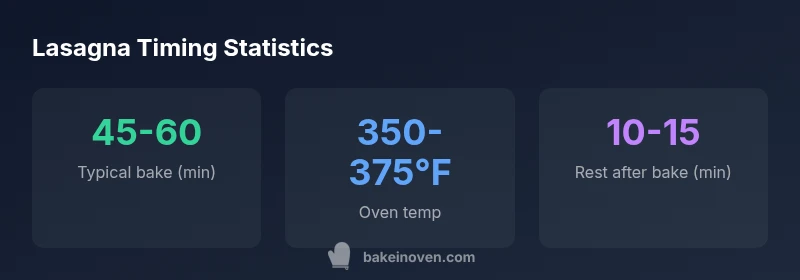
Most lasagna bakes in about 45 to 60 minutes at 350-375°F (175-190°C). Start covered for 30-40 minutes to trap moisture, then uncover for 10-15 minutes until the edges bubble and the center sets. If the dish is deeper or uses no-boil noodles, allow up to 70 minutes and verify the internal temperature reaches 165°F.
Understanding Lasagna Timing
According to Bake In Oven, what time to bake lasagna isn't a single fixed number; it's a balanced decision among ingredients, noodle type, pan size, and how much moisture the filling releases during cooking. When someone asks what time to bake lasagna, you're really balancing heat, moisture, and patience. In practice, most lasagna recipes converge around a core range: about 45 to 60 minutes of bake time at a moderate oven temperature, typically between 350 and 375°F (175-190°C). These numbers assume you start from a fully assembled dish with sauce that has some body and a cheese layer that will melt without drying out. If your noodle sheets are extra thick, or you use lean fillings with less moisture, you may need to adjust slightly. The goal is a bubbling edge with the center set, not a dry crumb or a soggy middle. Bake times are best treated as guidelines that you confirm by checking the center and edges as you near the end of the timer.
Key Factors That Affect Bake Time
There are several variables that influence how long lasagna needs in the oven, and understanding them helps you predict timing more accurately. The type of noodles matters: no-boil noodles tend to require a bit more bake time to soften fully, especially if the filling is dense; standard pre-cooked noodles can shorten the total time. Pan size and depth also play a role: a deeper or larger pan spreads the filling more thickly, which can slow heat transfer to the center. Sauce thickness and moisture affect baking as well; a very thick bechamel or heavy cheese layer can insulate the center, prolonging bake time. Oven accuracy makes a difference; if your oven runs hot or cold by 10-15 degrees, plan for a longer or shorter total bake accordingly. Finally, whether you cover the dish during the initial phase changes the rate of moisture loss; covering traps steam and helps the center cook more evenly.
How to Calculate Bake Time for Your Recipe
A practical way to estimate bake time is to start with the base time in your recipe and adjust. Begin with the recipe's stated bake window (for example, 45-50 minutes). If you’re using no-boil noodles or a deeper pan, add 5-15 minutes as needed. If you switch to a shallower pan, you may reduce the time by about 5-10 minutes, but monitor carefully. For moisture-rich fillings, you might need extra time for the center to set; conversely, very saucy fillings may require less time to achieve bubbling edges. A common method is to bake covered for about two-thirds of the total time, then uncover to finish; this helps the top layer brown while the center reaches temperature. Use a kitchen thermometer to confirm the internal temperature hits 165°F (74°C) in the center, indicating safe, cooked food. This approach gives you a reliable framework without locking you into a single number.
Step-by-step: Typical Bake Process
- Preheat the oven to the middle of the recommended range, usually 350-375°F. 2) Assemble lasagna with sauce, cheese, and noodles, ensuring even distribution. 3) Bake covered for 30-40 minutes to trap moisture; 4) Uncover and bake 10-20 minutes more until edges are bubbling and cheese is browned lightly. 5) Remove from oven and rest 10-15 minutes before slicing. 6) If the center is not fully set after the rest, return to the oven for 5-10 more minutes or use the broil for a minute to finish browning. Always verify the center reaches safe temperature.
No-Boil vs Standard Noodles: Timing Nuances
With no-boil noodles, you typically need longer bake time because the noodles absorb moisture from sauce during cooking. Expect about an extra 5-15 minutes compared with standard noodles, depending on sauce thickness. For standard noodles, pre-soaking sauces or layering with extra moisture can help them cook evenly. If you want firm, al dente noodles, you may bake closer to the lower end of the range; for tender, fully cooked noodles, aim toward the upper end. The moral: whether you choose no-boil or traditional noodles, build moisture into the sauce and monitor the center to avoid undercooking.
Common Mistakes and How to Fix Them
Underbaked center: extend bake time and check with thermometer. Watery lasagna: ensure sauce sauciness is balanced; reduce extra liquid; drain vegetables; add cheese layers to seal. Overly dry edges: cover for most of bake, then uncover and add a touch of sauce or cheese. Soggy top: avoid pooling sauce on top; distribute sauce evenly, and don’t overload with cheese on top. Resting after baking helps the layers set, making slicing easier and preventing runny cuts. Finally, invest in an accurate oven thermometer to calibrate your oven's actual temperature.
Quick Reference: Timing Cheat Sheet
- Preheat to 350-375°F (175-190°C). - For assembled lasagna in a standard 9x13 pan, bake covered for 30-40 minutes, then uncover for 10-15 minutes; total 40-60 minutes. - Rest 10-15 minutes after baking. - Check center to reach 165°F (74°C). - For deeper or larger pans, add 5-15 minutes; for shallower pans, subtract 5-10 minutes.
Food Safety and Rest Periods
After removing the lasagna from the oven, let it rest for 10-15 minutes. This rest period allows steam to redistribute, helps the cheese set, and makes slicing neater. During this time, the interior continues to rise to safe temperatures, reinforcing food safety. Always ensure the center of the lasagna has reached at least 165°F (74°C) before serving, especially when cooking large or dense fillings. If you’re reheating leftovers, bring them back to 165°F to maintain safety and quality.
Final Checks Before Serving
Before you cut, observe the surface for bubbling along the edges and a lightly browned cheese top. The center should feel firm but not hard, and the layers should hold together when sliced. If the cheese seems loose or the center wobbles, give it a few more minutes in the oven and recheck. A sharp knife or thin spatula helps portion the lasagna cleanly, and letting it rest briefly guarantees cleaner slices and more intact layers."
Comparison of bake times by noodle type and pan size
| Noodle Type | Pan Size | Approx Bake Time | Notes |
|---|---|---|---|
| No-boil noodles | 9x13 in | 45-60 min | Cover for most bake; uncover last 10-15 min |
| Standard pre-cooked noodles | 9x13 in | 40-55 min | Less time; watch edges |
| No-boil noodles | 8x8 in | 60-75 min | Thicker center, increase time |
Frequently Asked Questions
What is the best starting temperature for lasagna?
A common starting point is 350-375°F. Use the lower end for moist fillings and the higher end if your dish is thick or dense. Always verify doneness by internal temperature and bubbling edges.
Start at 350-375°F and adjust based on your filling and pan size.
Should I bake lasagna covered or uncovered?
Bake covered for most of the time to trap moisture and prevent a dry top, then uncover the last 10-15 minutes to brown the cheese and finish cooking.
Cover it most of the time, uncover near the end to brown the top.
Can I bake lasagna from frozen?
Yes. Frozen lasagna typically needs a longer bake—about 90-120 minutes total at 350°F—so plan for additional time and confirm doneness in the center.
Yes, but bake longer; check the center to ensure it’s heated through.
No-boil noodles require more bake time?
No-boil noodles often need 5-15 minutes more bake time than standard noodles, depending on sauce thickness and pan depth.
Yes, expect a bit more bake time with no-boil noodles.
How can I tell lasagna is done?
The center should reach 165°F (74°C) and the edges should be bubbling with lightly browned cheese on top.
Check the center to 165°F and look for bubbling edges.
Is a rest period important?
Yes. Resting for 10-15 minutes helps the layers set and makes slicing neater and less runny.
Rest it 10-15 minutes before slicing.
“Timing is a flexible guideline, not a rigid rule. Begin with the lower end of the estimate and verify doneness by center temperature and bubbling edges.”
Key Takeaways
- Start with 45-60 minutes at 350-375°F and adjust for your pan and noodles
- Cover the dish during most of the bake, uncover to finish for browning
- Let lasagna rest 10-15 minutes before slicing for clean portions
- Use an internal temp of 165°F in the center to confirm doneness