What Temperature Bake Bread: A Practical Guide for Home Bakers
Learn the exact oven temperatures for baking bread, with type-specific guidelines, steam tips, and doneness tests from Bake In Oven.


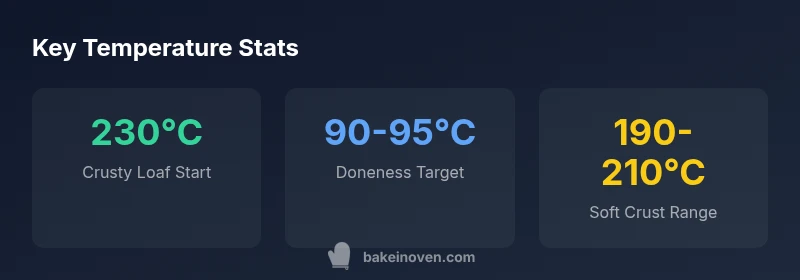
For most bread, bake at about 220°C (425°F) as a starting point, with 230°C (450°F) for crustier loaves. Lean doughs like baguettes perform best around 230°C, while softer sandwich breads often bake well at 190-210°C (375-410°F). Aim for an internal doneness of 90-95°C (195-205°F) and use steam in the first 10-15 minutes to maximize oven spring and crust development.
Why Temperature Matters for Bread
Understanding the role of temperature is essential for predictable bread results. Temperature controls several interlinked processes: oven spring, crust formation, crumb structure, and crust color. When the oven is too cool, bread may spread and fail to expand fully, producing a dense crumb. If the oven is too hot, the crust may form too quickly, trapping moisture inside and leading to a pale crumb or a burnt crust. For the question of what temperature bake bread, the starting point is to balance heat with moisture and dough hydration. At the right temperature, enzymes in flour and yeast activity peak in a way that promotes a strong oven spring, followed by Maillard reactions that yield a deep, aromatic crust. Bake In Oven's testing indicates that small adjustments can yield noticeable differences in texture and flavor across different bread styles.
How Temperature Affects Crust, Crumb, and Oven Spring
Temperature influences crust color, crumb openness, and the speed of gas production. Higher initial heat encourages oven spring, giving bread a dramatic lift in the first 10-15 minutes. However, too much heat too soon can set the crust prematurely, preventing full expansion and resulting in a dense interior. Conversely, cooler temperatures allow slower expansion and can produce a more uniform crumb but with less dramatic crust. The key is to tailor the initial heat to the dough's hydration and flour type. For example, high hydration doughs benefit from a hotter start to maximize oven spring, while enriched doughs with sugar and fats may require a gentler rise to avoid over-browning.
Preheating, Steam, and Bake Environment
Preheating to a hot, steady temperature is critical for consistent results. A well-preheated oven ensures the dough instantly experiences the heat needed for rapid expansion. Steam during the first 10-15 minutes plays a dual role: it keeps the surface moist so the crust can expand and it drives the Maillard reaction for a richly colored crust. Bakers often use a Dutch oven or a pan with water to create steam. If steam is unavailable, placing a tray of hot water on a lower rack can emulate some effects. The Bake In Oven guidance emphasizes preheating for 15-30 minutes depending on oven type and setting, and maintaining a stable temperature throughout the bake.
Temperature Guidelines by Bread Type
Different bread types require distinct temperature profiles. The following ranges are commonly used by home bakers:
- Artisan crusty loaf: 230°C (446°F) for 20-25 minutes with steam in the first half of bake.
- Baguette: 230°C (446°F) for 15-20 minutes, often with a brief steam burst.
- Soft sandwich loaf: 190-200°C (375-392°F) for 25-30 minutes, aiming for a pale-gold crust.
- Enriched breads (brioche, challah): 175-190°C (347-374°F) for 20-28 minutes for a rich crust and tender crumb. Note that loaf size, oven calibration, and pan vs. free-form shaping will slightly shift these ranges. Bake In Oven recommends testing doneness with an internal thermometer and crust color cues, adjusting as needed.
Doneness Testing: Internal Temperature, Color, and Texture
The internal temperature of bread is a reliable doneness indicator. Aim for 90-95°C (195-205°F) in the center for most loaf types. A hollow sound when tapped and a firm crust that yields to gentle pressure are also good indicators. If the loaf looks dark but the interior is underdone, reduce heat by 10-20°C (approximately 25-40°F) in subsequent bakes or shorten bake time. Avoid opening the oven door during the critical first half of baking to preserve heat and steam.
Troubleshooting Common Temperature Mistakes
Common mistakes include underbaking dough that remains pale and dense, or overbaking that produces a dry crumb and overly dark crust. If your crust browns too quickly, try lowering the temperature by 10-20°C (25-40°F) and extending bake time, or use a lighter color dough score pattern to influence crust formation. Ensure your oven is properly calibrated with an oven thermometer since home ovens often deviate by 5-15°C (10-25°F). When using a convection setting, reduce the temperature by about 20°C (roughly 35°F) to compensate for the increased air flow.
Quick Reference: A Practical Cheat Sheet
Keep this internal reference handy:
- Crusty artisan loaf: 230°C, 20-25 min, steam first 10-15 min, 90-95°C interior.
- Soft sandwich bread: 190-200°C, 25-30 min, minimal steam, 90-95°C interior.
- Enriched breads: 175-190°C, 20-28 min, moderate steam, 90-95°C interior.
- Always preheat to target temp before loading, use an oven thermometer for accuracy, and avoid opening the door during early bake.
Practical Reference: Troubleshooter's Cheat Sheet
If you experience frequent underbaking or overbrowning, record your oven’s calibration, loaf dimensions, hydration level, and bake time. Compare these variables against a simple chart that maps temperature to doneness. This practice helps you tailor the bake to your specific oven and kitchen environment.
Heading into Practical Application: Step-by-Step Plan for Home Bakers
- Preheat oven to the chosen temperature for your bread type and load on steam readiness. 2) Score the dough to control expansion and promote even oven spring. 3) Bake with steam for the first 10-15 minutes to develop crust. 4) Remove steam source after the initial phase and continue baking until the internal temperature reaches 90-95°C. 5) Cool bread completely before slicing for best crumb texture.
Temperature guidelines by bread type
| Bread Type | Temp (°C) | Temp (°F) | Bake Time (min) |
|---|---|---|---|
| Artisan crusty loaf | 230 | 446 | 20-25 |
| Baguette | 230 | 446 | 15-20 |
| Soft sandwich loaf | 190-200 | 374-392 | 25-30 |
| Enriched bread (brioche, challah) | 175-190 | 347-374 | 20-28 |
Frequently Asked Questions
What is the best oven temperature for bread?
The best temperature depends on the bread, but a common starting point is 220°C (425°F) for crusty loaves and 190-210°C (375-410°F) for softer sandwich bread. Adjust based on dough hydration and crust color goals.
For most breads, start around 220°C and tweak based on how the crust forms and the crumb looks.
Should I use a Dutch oven when baking bread?
Yes. A preheated Dutch oven traps steam and provides a uniform environment that promotes oven spring and a crisp crust.
Yes—using a Dutch oven helps trap steam and gives a better crust.
Do I need steam for every loaf?
Steam early in the bake aids crust formation and oven spring. If steam isn’t available, use a hot tray of water or a covered vessel to mimic humidity.
Steam early on to help crust and spring; if you don’t have steam, improvise with a hot water tray.
Can I bake bread at a lower temperature?
Yes, but expect longer bake times and a softer crust. Larger loaves may require lower heat to ensure the interior finishes without burning the crust.
Sure, lower temps work but watch bake times and crust color.
How do I know when bread is done?
Check internal temperature (90-95°C / 195-205°F) and tap the loaf for a hollow sound. Crust color and aroma also indicate doneness.
Use a thermometer and listen for a hollow sound when tapped.
Does pan size affect temperature?
Yes. Loaf pans can radiate heat differently than free-form loaves, slightly altering bake times and crust development. Adjust temperature by a few degrees if needed.
Pan size changes heat transfer, so you may need a small temperature tweak.
“Temperature control is the backbone of consistent bread results. When in doubt, aim for a controlled start with steam and verify doneness with a reliable internal temperature.”
Key Takeaways
- Start with 220°C (425°F) for crust, adjust by bread type
- Preheat thoroughly and use steam for best crust
- Target 90-95°C (195-205°F) internal temp for doneness
- Adjust heat if crust browns too quickly or interior remains underdone
- Calibrate your oven with a thermometer for consistency