How Long to Bake Bacon at 350°F: A Crisp Guide
Learn how long to bake bacon at 350°F for crispy, evenly cooked slices. This Bake In Oven guide covers timings by thickness, doneness cues, and safe handling.


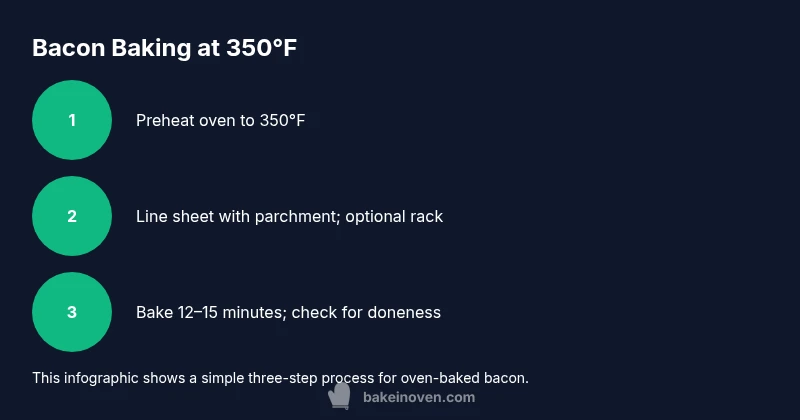
You will bake bacon at 350°F to achieve crispy, evenly cooked slices. For standard-cut bacon, target 12-15 minutes; for extra crisp, 15-20 minutes; for thick-cut bacon, 18-22 minutes. Start checking around the 12-minute mark to avoid overcooking.
Understanding how long to bake bacon at 350
Baking bacon in the oven at 350°F provides a reliable, hands-off approach to crispy results. This method minimizes splatter and keeps your stovetop clean. The exact time depends on bacon thickness, the presence of a rack, and whether you are using a standard or convection oven. Knowing how long to bake bacon at 350 helps you plan meals and avoid undercooked or overcooked slices. Always preheat to 350°F before laying out the slices so the heat is even from the moment you start. Arrange slices in a single layer and avoid overlapping, which can lead to uneven cooking. As the fat renders, you’ll see the edges turn golden and crisp while the centers set. If you’re unsure, start with a 12-minute baseline and extend in 1–2 minute increments until you reach your preferred crispness. With practice, you’ll build a sense for the browning pace of your oven.
Temperature, thickness, and doneness expectations
Times vary with thickness: standard-cut bacon generally crisps nicely in 12–15 minutes on 350°F; thick-cut typically needs 18–22 minutes for a firm texture. If you like chewier bacon, pull it closer to the 12–14 minute range and let it rest a minute to finish fat rendering. For extra crispness, add a few minutes (up to 20–22 minutes) and monitor closely near the end. Note that convection ovens can cook faster, so reduce time by 2–4 minutes if your oven uses a fan. Regardless of the cut, aim for evenly browned edges and fat that’s rendered but not burnt.
Prepping: equipment and sheet setup
Prepare a rimmed baking sheet and optional rack. Line with parchment paper or foil for easy cleanup and fat collection. If you have a cooling rack, set it over the sheet so fat drains away and the bacon stays evenly crisp. Preheating is essential; cold bacon straight from the fridge will lower the oven’s heat an instant and lead to uneven results. Cut bacon slices in a single layer, leaving small gaps between pieces. Arrange from edge to center, so air can circulate around each strip.
How to test for doneness and rest time
Visual cues are the simplest: edges should be golden brown and the fat should appear translucent and rendered. The bacon will continue to firm up a bit after you remove it from the oven, so pull it when it looks slightly underdone if you want maximum juiciness. Use tongs to transfer to a paper towel–lined plate and blot gently to remove surface fat. Let it rest for 1–2 minutes before serving; this helps the texture set and helps flavors settle.
Variations and tips for better results
If you have a wire rack, place the bacon on it for crisper results as fat drips away. Without a rack, parchment-lined sheet still yields great results; you may need to rotate the pan halfway through to promote even browning. For extra flavor, brush lightly with maple syrup or sprinkle brown sugar and cracked pepper; use sparingly so you don’t burn. If your oven runs hot, reduce the temperature by about 15°F and extend the time slightly. To save time, bake multiple trays in a two-tier setup if your oven’s airflow allows it, rotating between racks every few minutes.
Common mistakes and troubleshooting
Common mistakes include overcrowding the pan, not preheating, and removing bacon too early, which leaves excess fat. Overcrowding traps steam instead of crisping, leading to limp slices. Not draining fat can make the bacon greasy and soggy. If your bacon seems to brown unevenly, rotate the pan 180 degrees or switch to a rack setup for even heat distribution. Always wash hands and keep a safe distance from hot fat, as splatter can cause burns. If you prefer extra crisp bacon, broil for 1–2 minutes at the end, watching carefully to prevent burning.
Authoritative sources
- U.S. Department of Agriculture Food Safety and Inspection Service (FSIS): https://www.fsis.usda.gov/food-safety/safe-food-handling-and-cooking-meat/bacon
- Centers for Disease Control and Prevention (CDC): https://www.cdc.gov/foodsafety/index.html
- U.S. Food and Drug Administration (FDA): https://www.fda.gov/food/buy-store-prepare-food/food-safety-education
Tools & Materials
- rimmed baking sheet(Rectangular sheet pan with raised edges to catch fat)
- parchment paper or aluminum foil(Line surface to prevent sticking and ease cleanup)
- wire rack (optional)(For crisper results by lifting bacon above fat)
- tongs(To turn slices and remove hot bacon safely)
- paper towels(Blot fat after cooking)
- oven thermometer (optional)(To verify true oven temperature)
- cooling rack or plate(For resting hot bacon)
Steps
Estimated time: 25-40 minutes
- 1
Preheat oven to 350°F
Set the oven to 350°F and let it fully come to temp. This establishes a stable heat environment so bacon cooks evenly from start to finish. Avoid adding bacon to a cold oven, which can lead to uneven rendering.
Tip: Preheating minimizes temperature drop when the bacon enters the oven. - 2
Line the sheet with parchment
Place parchment paper or foil on the baking sheet to catch fat and prevent sticking. This makes cleanup easier and helps maintain a consistent cooking surface.
Tip: Parchment is preferable to spray-on coatings for flavor and cleanup. - 3
Set up a rack (optional)
If you have a wire rack, place it on the sheet so fat can drain away and air can circulate. If you don’t have a rack, you can bake directly on the parchment; you may need to rotate for even browning.
Tip: A rack yields crisper bacon by allowing fat to drip away. - 4
Arrange bacon in a single layer
Lay slices in a single even layer without overlaps. Overlapping causes steam instead of crisp browning and leads to uneven results.
Tip: Leave small gaps between slices to promote air flow. - 5
Bake for 12–15 minutes (adjust by thickness)
Place the sheet in the oven and bake for 12–15 minutes for standard-cut bacon. Thicker cuts may need 18–22 minutes. Begin checking at the 12-minute mark to avoid overcooking.
Tip: Time varies by oven; rely on appearance rather than exact minutes. - 6
Rotate and test doneness
If possible, rotate the sheet halfway through to equalize heat exposure. Look for golden edges and rendered fat as signs of doneness. Remove when desired crispness is reached.
Tip: Rotating ensures even browning, especially in non-convection ovens. - 7
Remove and drain
Use tongs to transfer bacon to a plate lined with paper towels. Blot lightly to remove surface fat and let it rest for 1–2 minutes to finish crisping.
Tip: Resting helps the texture settle and reduces grease on contact. - 8
Serve or store
Serve immediately or cool completely and store in an airtight container in the fridge for up to several days. Reheat gently to preserve texture. You can also freeze for longer storage.
Tip: Reheat on a sheet in a 350°F oven for best results. - 9
Optional finish for extra crisp
If you want extra crisp, finish under the broiler for 1–2 minutes, keeping a close eye to prevent burning. This step is optional and not needed for most daily cooking.
Tip: Broil only briefly and watch carefully; bacon can go from perfect to burned quickly.
Frequently Asked Questions
What thickness of bacon is best for 350°F?
Standard-cut bacon typically cooks best at 350°F, with thin slices crispening quickly and thick-cut needing more time. Monitor for doneness to avoid overcooking.
Standard-cut bacon works best at 350°F; thick-cut may need more time. Watch for doneness as it renders.
How long should thick-cut bacon bake at 350°F?
Thick-cut bacon usually requires about 18–22 minutes at 350°F for a firm texture. Start checking around 18 minutes and adjust based on preferred crispness.
Thick-cut bacon needs roughly 18 to 22 minutes at 350°F. Check for your preferred crispness.
Is convection faster than standard baking at 350°F?
Yes, convection can cook bacon faster due to improved air circulation. If you use convection, reduce the time by a few minutes and keep a close eye in the final minutes.
Convection can shave a few minutes off the time; watch closely near the end.
Can I bake multiple sheets at once?
Yes, you can bake on multiple sheets, but avoid overcrowding and rotate the trays if your oven has even heat distribution. Time may be slightly longer.
Yes, but don't overcrowd and rotate if possible; expect a touch longer bake.
What’s the best way to test doneness?
Look for golden edges and fully rendered fat. Remove when the center looks set and the edges are crisp but not burnt.
Crisp edges and rendered fat are your cues; doneness should be uniform.
What should I do with the rendered bacon fat?
Store rendered fat in a heat-safe container for future cooking. Do not pour hot fat down the drain to avoid clogs.
Save the fat in a jar for later cooking; don’t pour it down the drain.
Watch Video
Key Takeaways
- Preheat to 350°F before adding bacon
- Cook in a single layer for even browning
- Use a rack if possible for crisper results
- Monitor doneness starting at 12 minutes
- Rest briefly and blot fat before serving