How Long to Oven Bake Chicken Legs: A Complete Guide
Discover precise oven bake times for chicken legs, with temps, doneness targets, and tips from Bake In Oven to ensure juicy, safe results. Learn how to adapt times for size and oven performance.


Here’s the quick answer for how long to oven bake chicken legs: bake bone-in legs at 400–425°F for about 35–45 minutes, then test for an internal 165°F. This quick plan covers typical sizes and tips to prevent under or overcooking.
Why timing matters for chicken legs
Timing is the bridge between safe cooking and juicy, flavorful meat. The duration you bake chicken legs determines whether the skin becomes crisp and the meat stays tender, or if it dries out and toughens. Several factors influence the final result: the size and bone-to-meat ratio of the legs, the oven's heat profile, the presence of skin, and whether the legs start at refrigeration temperature or come closer to room temperature before cooking. According to Bake In Oven, precise timing starts with bone-in legs and a reliable thermometer, then adjusts for oven performance and piece size. When you bake legs that are all roughly equal in size, you minimize hot spots and get a more uniform finish. This article uses the fundamental question how long to oven bake chicken legs to guide you toward consistent results, not just a single recipe.
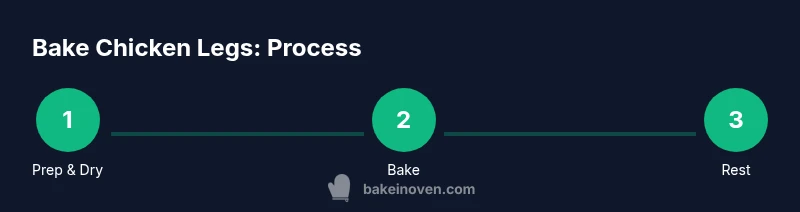
From there, plan for a short rest after baking. Resting allows juices to redistribute, which keeps the meat moist and makes slicing easier. If you work with mixed sizes, you may need to check individual pieces a few minutes apart, rather than relying on a single clock. The goal is not only to hit 165°F but also to create a crusty, appealing exterior that holds up when you serve it.
Understanding temperature and doneness
Doneness is more than a time stamp; it’s a temperature target. For poultry, the USDA and most food-safety guidelines identify 165°F (74°C) as a safe internal temperature for chicken. However, many cooks aim for slightly lower temperatures on the outside while ensuring pasteurized interior, then allow carryover cooking to finish inside. The thermometer should be placed in the thickest part of the meat, avoiding bone, to avoid reading a higher external temperature. Expect a brief rise in temperature after you remove the legs from the oven due to carryover heat, especially if you pull them at 160–162°F and let them rest. Resting for 5–10 minutes helps juices redistribute and improves slicing quality.
If you’re new to testing doneness, use an instant-read thermometer for quick checks on several pieces. Doneness isn’t just about a number; it’s about safe consumption with flavorful, moist meat. In practice, aim for 165°F and use the rest period to settle flavors and texture.
In this section, you’ll learn to balance safety, texture, and convenience by pairing temperature with time and technique, rather than relying on time alone.
Oven temperatures and times by cut and size
The most common scenario for home cooks is bone-in, skin-on chicken legs (drumsticks with attached thigh). At 400–425°F (204–218°C), these legs typically bake in about 35–45 minutes, depending on size and how crowded the pan is. If your legs are larger or closer to the 9–10 ounce range, you may need up to 50 minutes, especially if they’re touching or clustered. For smaller legs, 30–35 minutes can be sufficient. If you want to push maximum crispness, you can raise the oven to 425–450°F (218–232°C) for 30–40 minutes, but monitor closely to avoid overcooking. If you’re using boneless, skinless leg portions (less common but possible), plan on roughly 25–35 minutes at 400–425°F, with internal temp guiding the final check. The key is even spacing and a finish that yields golden skin with a firm bite.
A practical approach is to bake on a parchment-lined sheet with the skin side up, then flip or rotate halfway through the cooking time to promote even browning. If you’re cooking multiple trays, rotate their positions to equalize heat exposure. In all cases, rely on a thermometer for final doneness rather than the clock alone.
Oven performance varies, so use these ranges as starting points and adjust based on your oven’s behavior and leg size. Bake until the thickest piece reads 165°F in the center, then allow a brief rest.
One-pan method for crispy skin
Crispy skin starts with dry skin and high heat. Begin by patting each leg dry with paper towels to remove surface moisture. Lightly oil the skin and sprinkle with salt, pepper, and a bit of garlic powder or smoked paprika for color. Line a rimmed baking sheet with parchment paper for easy cleanup and to prevent sticking. Place a wire rack on top of the sheet if you have one; this lifts the meat for better air circulation and uniform browning. Arrange the legs at least 1–2 cm apart so air can circulate around each piece.
Preheat the oven to 400–425°F (204–218°C). Slide the sheet into the oven and bake for about half the total time, then rotate the tray to counteract any hot spots. If you’re using multiple trays, switch their heights as well. The goal is even heat exposure to deliver uniform browning and crisp skin. A final 5–10 minute exposure can yield a deeper color if desired, but watch closely to avoid burning.
Tips for success: pat dry again after a brief rest, use a thermometer to verify doneness, and avoid covering the legs during the bake to preserve crisp texture. The result should be juicy meat with crackly, flavorful skin and a clean bite.
Common mistakes and how to fix them
Common mistakes include under-seasoning, overcrowding the pan, and relying solely on time without thermometer checks. Crowded pan space traps steam, which prevents crisp skin and can leave meat underdone in the center. Overcrowded trays also cause uneven browning. To fix: give each leg space, use parchment to prevent sticking, and rotate trays during baking. Underseasoning leads to bland results; a light oil or butter coating with salt and a simple spice blend adds color and flavor. Another frequent error is pulling the chicken too early; always check the internal temperature first. If some portions reach 165°F while others lag, return the sheet to the oven for a few extra minutes and test again.
Cookware matters too: a dark nonstick sheet can absorb more heat and cause faster browning, while a light sheet may produce slower browning. If you notice uneven browning, try a wire rack or switch to a shallower pan to improve air flow. Finally, avoid sauces that are too heavy during the bake; they can hinder browning and promote soggy skin. A light glaze or brush of oil near the end can add gloss without softening the crust.
Serving and rest guidance
After removing the chicken legs from the oven, let them rest on a cutting board or warm plate for 5–10 minutes. Resting allows juices to redistribute and helps maintain moisture when you cut into the leg. During this time, you can prepare a simple pan sauce or drizzle a little lemon juice or herb oil for brightness. Slice near the bone to observe the texture and color; properly cooked chicken should have a light pinkish tinge absent, with clear juices running when pierced. Planning for rest also makes plating easier and reduces the risk of heat-heavy disappointment for guests. If you’re serving with sides, start them during the rest so everything finishes together. The overall approach—crisp skin, juicy meat, and proper resting—is the hallmark of well-executed oven-baked chicken legs.
(Optional) Quick recap for busy cooks
- Preheat oven to 400–425°F and prepare a parchment-lined sheet with space between pieces.
- Pat dry, oil lightly, and season generously.
- Bake 35–45 minutes, rotating halfway; test with a thermometer to reach 165°F.
- Rest 5–10 minutes before serving for best texture and juiciness.
Tools & Materials
- Oven thermometer(Use to confirm oven temperature matches setting.)
- Rimmed baking sheet(Prevents spills and keeps oven cleaner.)
- Parchment paper or silicone mat(Prevents sticking and aids cleanup.)
- Wire rack (optional)(Promotes air circulation for crisper skin.)
- Instant-read meat thermometer(Check thickest part for 165°F (74°C).)
- Tongs(Turn legs halfway for even browning.)
- Oil (olive or neutral)(Light coating helps crisp skin.)
- Paper towels(Pat dry surfaces to remove moisture.)
Steps
Estimated time: 50-60 minutes
- 1
Pat dry and season
Pat the chicken legs dry with paper towels and season generously with salt, pepper, and a simple spice blend. Let them sit at room temperature for 10 minutes to promote even cooking. Dry skin promotes crispness.
Tip: Pat dry thoroughly; surface moisture prevents browning. - 2
Preheat oven and prep pan
Preheat the oven to 400–425°F (204–218°C). Line a rimmed sheet with parchment and place a rack if available. Spacing is key for browning on all sides.
Tip: Use parchment to prevent sticking and make cleanup easier. - 3
Oil and season skin
Brush a light layer of oil over the skin and reapply seasoning if desired. Oil helps achieve a crisp, golden crust and enhances flavor.
Tip: Even coating ensures uniform browning across pieces. - 4
Bake and rotate
Bake the legs on the rack or sheet for about half the time, then rotate the pan or switch rack positions to balance heat exposure. Return to the oven and continue cooking until done.
Tip: Rotating prevents hot spots from creating uneven browning. - 5
Check temperature
Insert an instant-read thermometer into the thickest part of a leg, avoiding bone. Aim for 165°F (74°C). If not yet reached, continue baking in 3–5 minute increments and recheck.
Tip: Rely on internal temperature, not just time. - 6
Rest and serve
Remove from oven and rest for 5–10 minutes before serving to redistribute juices. Slice near the bone to test texture and ensure juiciness.
Tip: Resting improves moisture and makes carving easier.
Frequently Asked Questions
What internal temperature should chicken legs reach?
Chicken legs are safe to eat when they reach 165°F (74°C) in the thickest part. Use a thermometer and check near the bone, avoiding contact with bone for an accurate reading.
Aim for 165 degrees, checking the thickest part with a thermometer.
Should I bake with the skin on or off?
For crispness and flavor, keep the skin on. The fat and skin help baste the meat as it cooks, producing a juicier finish and a browner exterior.
Keep the skin on for crispness and flavor.
Does boneless chocolate leg matter? (Note: disregard unrelated item in context)
Bone-in legs are most common and usually yield better texture and browning. If you use boneless portions, reduce time by a few minutes and rely on the thermometer for doneness.
Boneless parts cook faster; monitor with a thermometer.
Can I bake chicken legs from frozen?
Cooking from frozen is not ideal for even doneness. If starting from frozen, plan for significantly longer cooking times and check internal temperature frequently to ensure safety.
It's best to thaw first for even cooking.
Should I use a meat thermometer every time?
Yes. A thermometer provides the most reliable indicator of doneness and helps avoid overcooking, especially with variable oven performance and leg sizes.
Yes, use a thermometer for best results.
How can I speed up the process without compromising safety?
Trim larger legs to uniform size, pat dry well, and use a preheated oven in the 400–425°F range. Do not shorten time without thermometer confirmation; safety comes first.
Uniform pieces and a thermometer keep it safe and quick.
Watch Video
Key Takeaways
- Preheat to 400–425°F for crisp skin
- Dry skin and oil lightly for even browning
- Internal temp should reach 165°F
- Rest 5–10 minutes before serving