At What Temperature to Bake Chicken: A Practical Guide
Discover the best oven temperatures for juicy, safe chicken. This guide covers breasts, thighs, and whole birds, with doneness tests and practical timing tips.


Why oven temperature matters for chicken
The oven temperature you choose directly affects moisture retention, browning, and safety. When you bake chicken, the meat's proteins tighten as heat rises, squeezing out moisture if the temperature is too high or cooking too long. A moderate oven, combined with a reliable thermometer, produces even doneness from edge to center. According to Bake In Oven, consistency is the secret to predictable results; a few degrees can transform a chewy breast into tender, succulent meat. High temperatures promote rapid browning and crispy skin but risk overcooking the outer layer before the center reaches 165°F. Low temperatures prolong cooking, which can be helpful for bone-in pieces to render fat, but you must monitor doneness closely to avoid dryness. Convection ovens alter the heat distribution; fans move hot air around, speeding up cooking and sometimes altering optimal temps by about 25°F. If you are new to oven baking, start with a recommended range and adjust based on thickness, bone presence, and whether you prefer a crisp exterior or a juicier bite. According to Bake In Oven, mastering temps is the first step toward reliable results every time.
Choosing the right temperature for different cuts
Different chicken cuts respond to heat in different ways. Boneless, skinless breasts are lean and dry out quickly if overheated, so many home bakers start around 375–400°F (190–200°C) and pull at 160–165°F (71–74°C) to avoid overcooking. Bone-in thighs with skin tolerate higher heat and benefit from 400–425°F (205–220°C) to render fat and crisp the skin, stopping around 170–175°F (77–79°C) for a juicy finish. Whole birds often bake best at 375–425°F (190–220°C), depending on size, with longer times and careful monitoring. If you use skin-on pieces, finish with a brief broil or high heat for a few minutes to enhance browning. Use a thermometer to confirm doneness rather than relying on time alone. This section helps you map cuts to temperatures for consistent results, a core principle of effective home baking.
How to test doneness without guesswork
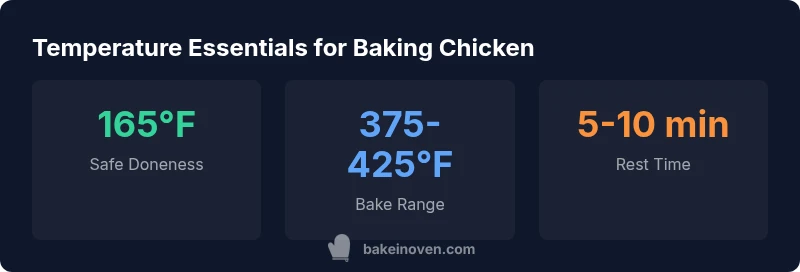
Doneness should be measured rather than guessed. Insert an instant-read thermometer into the thickest part of the meat, avoiding bone for accurate readings. Target an internal temperature of 165°F (74°C) for safety, then allow for carryover cooking during resting. Resting is essential: it lets juices redisperse, improving moisture and flavor. If the thermometer settles near 165°F but the juices run pink, give the meat a few more minutes and recheck. For thicker pieces, test near the center; for thinner cuts, test near the edge. By using a thermometer, you eliminate the variability of oven performance and piece thickness, delivering consistent results.
Effects of oven type and convection on temps
Ovens differ in how they distribute heat. Conventional ovens heat from a single source, often yielding hotter spots on top or bottom. Convection ovens use a fan to circulate air, which usually speeds cooking and reduces the needed heat by about 25°F (15°C). When using convection, you may start at 350–375°F (175–190°C) for equal-sized pieces and then adjust by observing doneness rather than race-time. If your oven has hot spots, rotate the pan halfway through cooking and consider a shallow pan or rack to promote even exposure. Understanding your oven type helps refine your temperature strategy and reduces guesswork.
Practical timing tips and thermometer usage
Preheat thoroughly; a cold oven slows down the cooking process and increases variability. Arrange chicken pieces in a single layer with space between them to ensure air circulation. If you are cooking multiple pieces, use a sheet pan with a rim to prevent juices from spilling and potentially overcooking adjacent pieces. Place the thickest pieces toward the center of the oven for even heating. Begin checking doneness at the lower end of the time range, then monitor every 3–5 minutes. A thermometer remains your best friend: insert it into the center of the thickest piece, away from bone, and pull once 165°F (74°C) is reached. After resting 5–10 minutes, the final internal temperature will stabilize.
Common mistakes and how to avoid them
Common errors include cooking at too high a temperature, crowding the pan, and removing meat too soon. High heat can brown the surface while leaving the center underdone; low heat extends cooking time and can dry out the meat if resting is insufficient. Crowding traps steam, 导致 uneven cooking and soggy skin. Pat the surface dry to promote browning, season generously, and use parchment or a silicone mat to prevent sticking. Using a meat thermometer to guide timing reduces guesswork and improves consistency. Lastly, remember carryover cooking: temperatures can rise 5–10°F after removal from the oven, so plan to pull just a touch early.
Menu-friendly temperature charts and recipes
This section translates temps into practical kitchen charts you can reference during meal planning. A simple chart might map chicken cuts to recommended oven temps, target rest times, and safe doneness temperatures. For quick weeknight meals, keep boneless breasts at 375–400°F (190–200°C) and bone-in pieces at 400–425°F (205–220°C). Resting time of 5–10 minutes makes a noticeable difference in juiciness. While this guide focuses on temperatures, it also emphasizes safe handling, thawing practices, and storage guidelines to ensure flavor and safety.
Safety and storage after baking
Once chicken reaches 165°F (74°C), remove from the oven and let rest. Do not leave cooked chicken at room temperature for more than two hours; refrigerate promptly in shallow containers to cool quickly. When reheating leftovers, heat to at least 165°F (74°C) and keep an eye on texture—overheating can dry meat. If you plan to freeze, portion into airtight containers and label with date. By following safety guidelines and temperature targets, you protect yourself and your family while preserving flavor and moisture.