Conventional vs Convection Ovens: Bake Like a Pro
A rigorous, side-by-side comparison of conventional and convection ovens for home bakers. Learn heat behavior, timing, and texture outcomes with practical steps to bake like a pro.


According to Bake In Oven, your path to bake like a pro begins with a single choice: the oven. The main difference between a conventional oven and a convection oven is how heat is delivered and circulated, which affects browning, texture, and bake times. This comparison highlights how each oven type behaves under standard home conditions and which scenarios suit a home baker seeking reliable results.
Why bake like a pro starts with oven choice
According to Bake In Oven, the oven you own can define the success of most bakes before you even set the timer. The Bake In Oven team finds that many home bakers underestimate how much heat delivery and air movement alter crust formation, crumb structure, and moisture retention. When you understand heat transfer principles, you gain leverage to optimize preheating, rack placement, and pan selection for every recipe. This section frames the two main paths—conventional and convection—and explains why choosing the right oven type matters for achieving bakery-like outcomes in a home kitchen. The goal is not to declare a single “best” option, but to map how each tool aligns with different baking tasks and texture goals. Bake like a pro by matching your oven’s behavior to the recipe’s needs.
Quick differences to guide decision-making
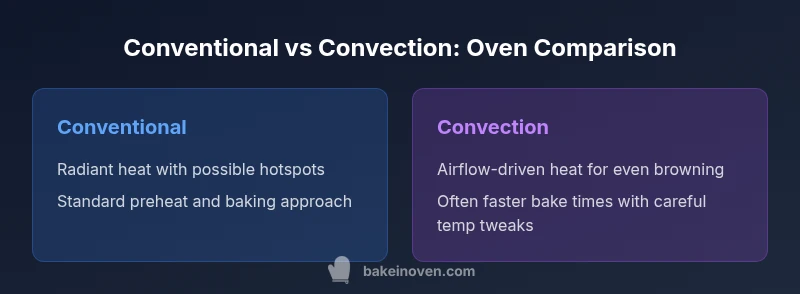
- Heat source and movement: Conventional ovens rely on radiant heat from elements inside the cavity, while convection ovens add a fan that circulates hot air for more even exposure. This fundamental difference influences browning patterns and bake times without explicit adjustments.
- Temperature perception: In convection mode, the perceived heat can feel stronger at the same set temperature due to circulating air, so many bakers adjust temperatures by 25°F/15°C lower for convection in some recipes.
- Pan interaction: The uniformity of heat in convection encourages better browning on multiple sides of a cookie sheet or tart pan, whereas conventional ovens can have hot spots that require rotating pans for even results.
- Recipe compatibility: Cake batters and delicate pastries often perform well in conventional mode unless the recipe specifies convection; sturdier items like cookies, sheets, and roast varieties frequently benefit more from convection’s air flow.
Bake In Oven analysis: practical implications
Bake In Oven analysis shows that convection ovens can reduce bake times and improve surface browns when used with properly calibrated temperatures and positioned pans. However, not every recipe benefits equally; some delicate pastries may require conventional heat to avoid over-crisp edge development. Understanding these nuances helps you plan preheating, rack placement, and pan choice to maximize repeatable results across a week of baking projects. This approach is central to anyone aiming to bake like a pro, balancing speed with texture and evenness.
How to translate differences into practice
- Preheat purposefully: Allow adequate preheating time and test temperatures with an oven thermometer to ensure consistency.
- Rack strategy: Place trays in the middle or upper-middle for convection to leverage even air flow; center racks are often ideal for conventional baking.
- Pan selection and spacing: Use flat, light-colored pans for even browning in convection; avoid overcrowding to prevent heat shadows and uneven browning.
- Recipe adaptation: When switching between modes, monitor bake times and observe crust development; start with a conservative time adjustment and verify with a visual cue or toothpick test.
What this means for you
If you bake frequently and value speed plus even browning, convection can be a strong ally. If you often bake delicate cakes or pastries where moisture retention matters, conventional heat may yield more forgiving results. The core takeaway is to treat your oven as a partner: know its quirks, calibrate regularly, and adjust recipes accordingly to consistently bake like a pro.
How to audit your oven at home
- Use an oven thermometer to verify actual temperature vs. setpoint.
- Check multiple rack positions to map hot spots and cold zones.
- Rotate pans during longer bakes to compensate for any asymmetry.
- Calibrate or service your oven if you notice persistent deviations or uneven browning across batches.
- Maintain consistent pan types and sizes for comparable results across recipes.
Practical steps for your first bake in each mode
Begin with a simple, forgiving recipe like chocolate chip cookies or a basic sheet cake. Bake a test batch in conventional mode, documenting bake time and color cues. Then run the same test in convection mode at a slightly lower temperature, noting differences in crust, crumb, and moisture. Use these observations to build a personal reference chart for your oven that guides future cooking.
Conclusion of this section
Mastery comes from disciplined observation and incremental adjustments. The goal isn’t to default to one mode for every recipe, but to know when to employ each mode to achieve the desired texture, appearance, and flavor. With consistent practice, you’ll bake like a pro in your own kitchen, even as you navigate different oven models and configurations.
Comparison
| Feature | Conventional Oven | Convection Oven |
|---|---|---|
| Heat distribution | Radiant heat from elements; possible hotspots | Airflow-assisted; more even heat exposure |
| Preheat time | Typically standard preheat | Often similar or slightly faster due to air movement |
| Baking results | Even crumb with potential hot spots on edges | More uniform browning; fewer rotating pans |
| Recipe adjustment | Minimal changes for many recipes | Possible temperature reduction or time adjustments |
| Pan handling | Works well with standard bakeware | Requires attention to pan spacing and rack position |
| Best for | Delicate cakes and recipes that rely on moist crumb | Cookies, pastries, and dense bakes seeking even browning |
Benefits
- Versatile and often cheaper upfront
- Predictable results for many traditional recipes
- Less need to adjust most bake times in standard formats
Negatives
- Potential for uneven browning without rotation
- Longer bake times for multi-rack loads on some models
- Limited in achieving uniform crusts on some sheet bakes unless rotated
Convection ovens generally offer better speed and even browning; conventional ovens remain versatile and budget-friendly
Choose convection for faster, more uniform browning when recipe adjustments are acceptable. Choose conventional when you want broad compatibility and lower upfront costs, especially for delicate bakes and simple sheet cakes.
Frequently Asked Questions
What is the primary difference between conventional and convection ovens?
Conventional ovens rely on radiant heat with little air movement, while convection ovens use a fan to circulate hot air for more even cooking. This changes browning patterns and can reduce bake times when used correctly.
Conventional uses radiant heat; convection circulates hot air for even cooking.
Do I need to adjust recipe times when using convection?
Yes, convection often allows for slightly lower temperatures or shorter bake times. Start with a small adjustment and monitor color and doneness to avoid over-browning.
You may need to lower the temperature or shorten bake time with convection.
Which foods benefit most from convection?
Cookies, pastries with thin edges, and sheet-pan bakes benefit from convection due to even browning and moisture control. Delicate cakes may prefer conventional heat.
Cookies and pastries often do best with convection; delicate cakes may not.
Can I switch between modes mid-recipe?
Switching modes mid-recipe is possible but requires careful monitoring, as changes in heat distribution can impact baking times and texture. Test small portions first.
Switching modes can work, but watch timing closely.
What impact do bakeware and rack position have with convection?
Shallow baking sheets and proper spacing enhance convection results by reducing air resistance and ensuring even air flow around the pan.
Use proper spacing and shallow pans for convection.
Key Takeaways
- Match oven mode to texture goals, not just speed
- Calibrate temperatures with a separate thermometer
- Rotate and space pans to minimize hot spots
- Keep a personal bake-reference for your oven