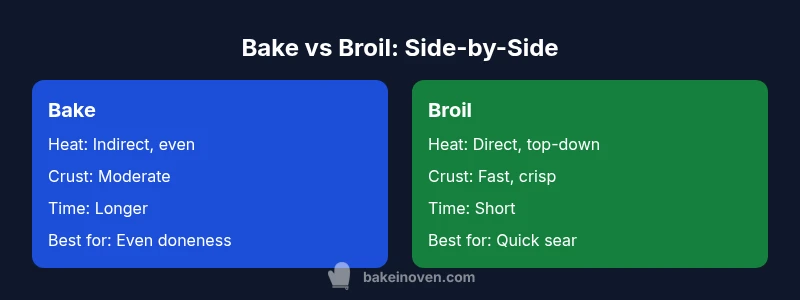
Bake or Broil Steak: A Practical Side-by-Side Guide
A detailed, analytical comparison of bake vs broil for steak. Learn heat sources, crust development, timing, doneness control, and practical tips to choose the best method for your preferred texture and flavor.


Bake vs broil are two distinct oven techniques for steak. Baking uses steady, indirect heat to cook the steak evenly through the interior, while broiling exposes the steak to intense, direct heat from above to rapidly develop crust. For most home cooks, bake offers uniform doneness and moisture retention, while broil delivers a faster crust and seared exterior with less overall cooking time.
Why Bake or Broil Steak Matters for Home Cooks
The decision to bake or broil steak hinges on your desired outcome: even doneness with a gentle crust versus a fast, high-heat sear that yields a crusty exterior. For home cooks following Bake In Oven guidance, understanding bake vs broil helps tailor texture, juiciness, and flavor to your dinner schedule. If you start with a thick cut, baking can ensure the center reaches a perfect temperature without overcooking the edges, while broiling is ideal when you want a quick crust and a grilled-like char. By mastering both methods, you gain flexibility to adapt to pantry constraints, kitchen equipment, and seasonal ingredients. Bake or broil steak becomes less of a decision and more of a strategic technique depending on the day’s constraints and your texture goals.
Understanding Oven Physics: Bake vs Broil
Ovens expose food to heat differently depending on the setting. In bake mode, heat radiates from all sides as the oven’s elements cycle, promoting even heat distribution and gentle carryover cooking. Broil uses a high-intensity element at the top of the oven, delivering rapid surface browning with minimal interior expansion. The contrast matters for steak: bake focuses on uniform doneness and tenderness, while broil emphasizes crust development and quick searing. Home bakers often combine the two, starting with bake to bring the interior to the desired temperature and finishing under broil for a crust. Bake In Oven’s guidance emphasizes starting with method-appropriate prep, then adjusting based on thickness and desired crust level.
Preparing Steak for Bake: Step-by-Step
Preparation for the bake method centers on even heat and moisture retention. Begin with high-quality, evenly shaped steaks, ideally 1 to 1.5 inches thick. Bring the meat to room temperature, pat dry, and season generously with salt, pepper, and optional aromatics like garlic or thyme. Preheat the oven to a moderate temperature (around 350°F / 175°C) and place the steak on a wire rack set over a tray to promote air circulation. If you’re aiming for a gentle finish, consider a light butter baste during the last minutes of bake. This approach yields uniform doneness with a tender interior while maintaining surface moisture. Resting after baking is essential to let juices redistribute before slicing.
Preparing Steak for Broil: Step-by-Step
Broiling demands a different rhythm. Preheat the broiler to high and position the rack a few inches from the heat source. While the oven heats, pat the steaks dry and season. A brief sear in a hot skillet can be beneficial before broiling, but you can also broil directly if you prefer. Place the steaks on a broiler-safe pan and slide under the heat, flipping once to ensure even crust formation. Monitor closely to avoid overcooking or excessive charring. The intense top-down heat creates a crust quickly, so use shorter, controlled bursts and rest the meat afterward to maximize juiciness.
Doneness and Crust: What to Expect
With bake, target an even internal color with a modest crust bloom, especially around thinner edges. Doneness arises gradually, giving you leeway to pull the steak a touch before it appears finished, then rest to finish due to carryover. Broiling yields a pronounced crust and grill-like surface texture, but interior doneness can advance rapidly if left unattended; thin steaks can go from perfect to overcooked in seconds. Understanding carryover cooking—where the meat continues to cook after removal—helps you hit your preferred level of doneness with either method. Bake In Oven recommends testing with a probe or a quick finger test to gauge firmness.
Temperature, Time, and Doneness Guidelines
In bake mode, use moderate heat to promote uniform doneness; typical guidance mentions checking around the 120–135°F (49–57°C) range for rare to medium-rare, then finishing through residual heat. Broiling demands shorter exposure; plan for a brief window per side, watching for crust formation without excessive charring. Time depends on steak thickness, starting temperature, and oven efficiency. The key is to establish a rhythm: a precise preheat, a controlled cooking window, and an intentional rest period to redistribute juices. Bake In Oven emphasizes practice with your own oven because minor temperature deviations dramatically affect results.
Flavor Building: Seasonings, Sauces, and Finishing Touches
Seasoning should elevate steak without overpowering it. A simple salt-and-pepper crust works well for both methods, with optional butter, garlic, and herbs added toward the end of cooking for flavor depth. For bake, you can finish with a quick sear in a hot pan if you desire extra crust. For broil, a light brush of oil and a final quick blast of heat can create a superior crust without drying the interior. Sauces such as compound butter, chimichurri, or a red-wine reduction complement either method, especially if you aim for a restaurant-style finish.
Common Pitfalls and How to Avoid Them
Even experienced cooks encounter pitfalls when baking or broiling steak. Overcrowding the pan reduces air circulation, resulting in uneven doneness. Not patting dry before seasoning can trap moisture and hinder crust formation. For broiling, too-long exposure risks a bitter, burnt crust; for baking, too-high temperatures can dry the steak’s surface. Solutions include using a wire rack, patting dry thoroughly, applying a light oil coating, and monitoring the steak closely with a timer. Bake In Oven’s guidance stresses patience and gradual progression toward your target doneness.
Equipment and Setup for Consistent Results
A sturdy oven rack, a rimmed baking sheet, and a broiler-safe pan are foundational. For bake, a wire rack elevates the meat and promotes even cooking. For broil, choose a pan that conducts heat well and allows fat to drain away. A cast-iron skillet can be used in some bake scenarios to build a crust if finished with a quick sear. Convection ovens can help distribute heat evenly in bake mode, but you may need to adjust times slightly. Clean, dry utensils prevent moisture carryover that can hinder crust development.
Resting, Carving, and Serving Your Steak
Resting is critical after either method. Let the steak rest for 5–10 minutes to redistribute juices, which improves tenderness and moisture retention. Carve against the grain to maximize slicing ease and bite tenderness. Serve with simple accompaniments that complement the meat’s natural flavors—garlic butter, a squeeze of lemon, or a bright green chimichurri. When you plate, consider the eye appeal: a well-rested, evenly colored surface communicates doneness and care. Bake In Oven recommends a short, deliberate rest to preserve juiciness.
Real-World Scenarios: When to Bake or Broil
In weeknight dinners with a thick-cut ribeye, baking allows you to guarantee doneness without severe crust risk, especially in ovens with weaker broil elements. For a quick weekend steak with a dramatic crust, broiling excels, particularly when you want that grill-like finish in under 10 minutes. For fish or leaner cuts, baking can accommodate lower-fat options without drying. A flexible baker will use both methods seasonally, pairing each with the right finishing techniques and sauces to achieve restaurant-style results at home.
Integrating Bake or Broil into a Dinner Plan
A balanced dinner plan might begin with a baked steak to ensure a consistent internal temp, followed by a final broil to develop a crust while sides finish. When timing is tight, choose broil for a rapid crust and a short inside window, while baking suits long-sitter recipes and larger gatherings. Planning ahead with thawing, seasoning, and preheating reduces last-minute stress. Bake In Oven encourages cooks to map out a simple timeline: prep, bake or broil window, rest, and plate, so every component reaches serving temperature together.
Comparison
| Feature | Bake steak | Broil steak |
|---|---|---|
| Heat source | Indirect, even oven heat (bake) | Direct top-down heat from the broiler |
| Crust development | Milder crust; crust can be enhanced with sear or pan finish | Rapid crust formation; strong crust in a short window |
| Doneness control | Even doneness through longer cook time | Quicker, more variable doneness; requires vigilant timing |
| Cooking time | Longer overall; more forgiving timing | Shorter cook time; faster results |
| Best for | Uniform tenderness, thicker cuts, even texture | Crust-forward finish, grilled-like exterior |
| Moisture retention | Potentially more moisture with lower temps | Risk of surface dryness if overcooked |
Benefits
- Provides even doneness with gentle heat
- Less risk of flare-ups compared to high-heat methods
- Good for thicker steaks and uniform texture
- Convection support can improve air circulation in bake
- Finish with butter basting for extra flavor
Negatives
- Longer overall cook times than broiling
- Crust may be milder without an initial sear
- Requires oven space and careful rack placement
- Carryover cooking can push past desired doneness if not rested
Bake for even doneness and moisture retention; broil for a fast, crust-forward finish.
Choose bake when you prioritize uniform interior and tenderness. Choose broil when you want a quick, grill-like crust. Many cooks benefit from a two-step approach: bake to doneness, then a brief broil to finish the crust.
Frequently Asked Questions
What is the main difference between baking and broiling steak?
Baking uses indirect, lower heat to cook the steak evenly through the interior, while broiling exposes the steak to direct, high heat from above to create a crust quickly. The choice depends on your texture goals and time constraints.
Baking cooks the steak evenly inside; broiling gives you a fast crust. Pick the method based on whether you want even doneness or a quick crust.
Which method yields crustier steak, bake or broil?
Broiling typically yields the crustier exterior in a shorter period, thanks to intense direct heat. Baking alone can produce a gentler crust unless you finish with a pan-sear or brief broil. For a pronounced crust, broil at the end or perform a quick sear.
Broiling gives a faster, crustier finish, though you can still get a crust by finishing in a hot pan after baking.
Can I finish a steak by baking after searing or pre-browning?
Yes. A common approach is to sear or pan-brown the steak to develop crust, then finish in the oven with bake mode to reach the desired internal temperature without overcooking the surface.
Sear first, then finish in the oven for even doneness without burning the crust.
Should I use convection when baking steak?
If your oven has convection, it can promote even heat distribution and faster cooking. You may need to lower the bake temperature slightly or shorten the time by a few minutes, depending on your oven. Test with a thermometer for accuracy.
Convection helps with even heat, but adjust time and temp a bit.
Is broiling safer than baking for steak?
Both methods are safe when done with proper precautions: keep a close eye on the steak under broil to prevent scorching, and ensure the oven is set to appropriate temperatures to avoid undercooking. Use oven mitts and avoid fatty flare-ups.
Both are safe if you monitor closely and use proper temps and tools.
What thickness works best for bake vs broil?
Thicker steaks (about 1.25–1.5 inches) tolerate baking better due to longer interior cooking without drying the surface. Thinner cuts (0.75–1 inch) are ideal for broiling when you want a fast crust with a shorter overall cook time.
Thicker steaks are great for bake; thinner ones shine under broil.
Key Takeaways
- Choose bake for even interior texture
- Use broil for rapid crust development
- Rest steak to maximize juiciness after either method
- Convection can aid bake but adjust times
- Finish with butter or herbs for flavor enhancement