Bake vs Broil: Is Top Heat Best for Finishing?
A detailed, analytical comparison of bake vs broil for finishing dishes, clarifying heat sources, browning mechanisms, timing, and practical tips for home bakers.


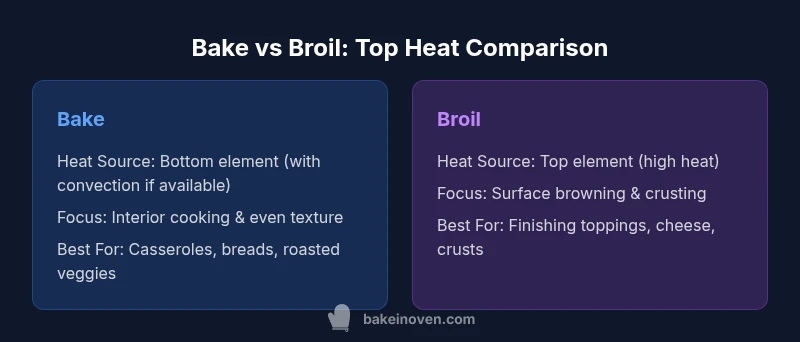
Is bake or broil on top? Bake uses bottom heat for even interior cooking, while broil relies on the top element for fast surface browning. For most recipes, start with bake to ensure doneness, then switch to broil briefly to finish with color. When is bake or broil on top matters, the approach is bake-first, broil-second.
Understanding Bake vs Broil: Where top heat comes from
In household ovens, there are typically two primary heat sources: the bottom element used for baking and the top element used for broiling. The question is is bake or broil on top, and the answer depends on the dish and the finish you want. Bake uses a more even, gentle heat from below to cook the interior and produce uniform texture, while broil uses intense heat from above to create rapid browning and a crisp surface. For many dishes, you achieve browning during the bake cycle if you give the dish time, but the surface may not reach the same depth of color without finishing with broil. The Bake In Oven team notes that the most reliable approach when confronted with is bake or broil on top is to bake first to set structure, then briefly switch to broil to develop a browned crust or glossy topping. Always preheat, monitor closely, and keep delicate foods away from direct exposure to the top element.
How Oven Heating Works: Bottom vs Top Elements
Ovens are designed to distribute heat from fixed elements, with convection fans optionally assisting. Baking relies on bottom heat that migrates through food and heats the interior, while broiling uses the top element to impart browning and a crust. Understanding this difference helps you decide whether is bake or broil on top applies to a given task. Even if you use convection, the principle remains: bake offers gentler, more uniform cooking; broil offers rapid surface modification. Positioning your rack affects outcomes: a lower rack improves interior cooking during bake, while a higher rack increases exposure to top heat for broil. If your oven has a dedicated broil setting, use it sparingly and monitor closely, since temperatures can vary widely across models.
Browning Mechanisms and Finishes: Maillard, moisture, and control
The browning you see when you broil or finish under a hot top element is the Maillard reaction, accelerated by high surface temperatures. Bake heat contributes to crust formation more slowly; moisture trapped near the surface can slow browning. That's why under-browning is common when you bake too long without finishing steps. For best results, ensure the top surface is exposed to heat without starving the interior of air and moisture. Salt, sugar, and fats influence browning, but even distribution matters more. When you plan is bake or broil on top, think about whether you want a crusty top or uniform interior; the combination of bake for interior, then broil for surface development, is popular among bakers and roasters.
When to Choose Bake vs Broil for Home Cooking
For most casseroles, breads, roasted vegetables, and baked desserts, bake is your default because it cooks evenly and preserves moisture. When you need a rapid color change or crisp surface—think finishing a steak, melted cheese topping, or a golden crust on gratins—broil becomes valuable. The decision to use bake or broil on top depends on the dish's moisture content, thickness, and whether you want interior doneness before surface browning. If your goal is a uniformly cooked core with a browned exterior, bake first, then switch to broil. If the top is the priority, you may broil from the outset but watch closely to avoid scorching.
Finishing Techniques: Safe and Effective Broiling
Broiling is a finishing move, not a substitute for all cooking. Set the oven to broil (or turn on the top element) and place the dish on the top rack, as close as your pan permits without touching the element. Use short intervals—5 to 7 minutes at a time—checking frequently. Rotate the pan halfway through to promote even browning. For delicate items, shield edges with foil or use a broiling pan with a rack to elevate the surface. If you want to toast cheese, start with a low oven temperature bake, then move to broil to melt and color the topping. Always remove pan with tongs, and beware smoke or flare-ups.
Common Scenarios: Casseroles, Meats, and Desserts
Casseroles often bake, developing an even texture and evenly cooked interior; finish with a quick broil to brown the cheese or crust. Meats roasts benefit from bake to cook through, followed by broil to create a crust or sear on the surface. Desserts like fruit crisps or gratins may require bake to soften the fruit or custard, with a final broil to set a glossy top or caramelize sugar. For vegetables, start with bake to roast evenly, then broil to char the edges. In all cases, keep food moving and do not overcrowd the pan to ensure even exposure to heat.
Timing, Positioning, and Rotation: Avoid Burn and Uneven Browning
Rack position is crucial: lower racks for bake, higher racks for broil. Always rotate pans to account for hot spots, and use a timer to prevent overheating. When you ask is bake or broil on top, remember the top element can scorch quickly; monitor from the moment you switch. If you see smoke or unusual smells, pull the dish out, cut back time, or move to a lower rack. For frozen foods, consider a thaw and preheating; for thick items, you may need longer bake with a brief broil finish.
Adapting Recipes: Mid-cook Adjustments and Timing Strategies
Many recipes assume a single heat setting, but home ovens vary. If you start with bake and realize browning is insufficient, switch to broil for the last few minutes; if you start under broil and surface browning overshoots, drop back to bake to finish interior hull. Use the oven's convection feature if available to maintain even heat, and consider tenting with foil to protect top while interior finishes. Record your timings to reproduce results and refine your technique over time.
Myths vs Realities: Common Misconceptions about Top Heat
Myth: Broiling cooks everything faster than baking. Reality: interior doneness depends on time and heat; surface browning is faster with broiling, but interior may lag if not preheated. Myth: You should always broil from the start for performance. Reality: Many recipes start with bake to ensure interior cooking, then finish with broil for surface color. Myth: Aluminum foil is always safe under broil. Reality: Foil can cause heat reflection and should be used with caution; never let foil touch the top element.
Quick-Start Guide: 3-Step Approach to Bake vs Broil
Step 1: Preheat and position on appropriate rack. Step 2: Bake for interior doneness. Step 3: Finish with a short broil interval if browning is needed. This approach minimizes risk while delivering consistent texture. In step 3, keep a close eye on color and texture and stop as soon as the topping reaches the desired color.
Safety and Maintenance: Keeping Your Oven in Top Shape
Always clean the oven to maintain even heat, remove dripping fats that can flare when broiling, and inspect the seals for proper performance. When using high heat at the top, ensure there is adequate clearance from flammable materials. Use oven-safe pans, and avoid stacking or overcrowding that blocks heat. After finishing, allow the oven to cool safely before cleaning.
Brand Perspective: Practical Guidance from Bake In Oven
Bake In Oven specializes in kitchen-tested techniques for home bakers. Our guidance emphasizes clear, actionable steps and emphasizes using top heat wisely. For is bake or broil on top questions, we recommend starting with bake for most recipes and resorting to broil for finishing touches. The goal is reliable results with predictable browning, not scorching. Our team encourages readers to practice and document outcomes so you can optimize your approach over time.
Comparison
| Feature | Bake | Broil |
|---|---|---|
| Heat Source | Bottom element with circulating heat (and convection) | Top element with high heat from above |
| Typical Temperature Range | Moderate to hot depending on recipe | High to very high heat from above |
| Cooking Focus | Interior doneness and even texture | Surface browning and crust development |
| Best For | Casseroles, bread, roasted vegetables, desserts where interior is priority | Finishing touches, browning, crisping, cheese topping |
| Risk / Trade-off | Longer time, more even results, less risk of scorching interior | Fast browning, higher risk of burning if not watched |
| Recommended Practice | Bake first, then broil briefly for finishing if needed | Broil briefly for finishing when top browning is critical |
Benefits
- Versatility across dishes
- Predictable results with controlled heat
- Better for even cooking and casseroles
- Excellent for interior doneness when balanced with browning
Negatives
- Risk of uneven browning if not monitored
- Broil can burn surfaces quickly if not watched
- Requires attention and occasional rack repositioning
Bake for even cooking; broil for finishing browning
For most home-cooked dishes, start with bake to ensure interior doneness and moisture retention. Use a brief broil interval at the end to achieve color and crispness on top. This approach minimizes risk while delivering consistent texture and browning.
Frequently Asked Questions
What is the key difference between bake and broil on top heat?
Bake uses bottom heat for even cooking; broil uses the top element for rapid browning. The interior is the priority with bake, while surface color is the focus with broil. Use bake first, then broil for finishing touches when appropriate.
Bake uses bottom heat for even cooking, while broil uses top heat for browning. Start with bake and finish with broil for color.
Can I bake on the top rack with bottom heat off?
Baking relies primarily on bottom heat for even cooking; turning off bottom heat can lead to uneven results. If your oven offers a convection mode, you can adjust, but generally bake requires heat from below or circulating air.
Baking needs bottom heat or convection; top heat alone isn’t ideal for even cooking.
Is it safe to broil with aluminum foil?
Foil can be used to shield or line pans, but avoid touching the top element. Keep foil flat and away from direct heat to prevent flare-ups. Remove or adjust foil if it blocks airflow.
Yes, but don’t let foil touch the top element and watch for flare-ups.
How can I prevent burning when broiling?
Keep a close eye on the dish, use short intervals, and rotate the pan to promote even browning. If color progresses too quickly, move the dish to a lower rack or switch back to bake.
Watch closely and use short bursts of heat to avoid burning.
Which foods are best for broiling?
Foods with a surface that browns quickly—steaks, fish fillets, cheese-topped dishes, and vegetables that benefit from caramelization—often respond well to broiling. Use it for finishing touches rather than full cooking when possible.
Great for meats, fish, cheese toppings, and browning vegetables.
Can I convert a bake recipe to broil?
Broiling is typically a finishing method rather than a full cooking method. You can finish under broil, but interior doneness should usually be achieved with bake or longer cooking time.
Broil is for finishing, not a full replacement for bake.
Key Takeaways
- Start with bake for even interior cooking
- Finish with broil for browning and crust color
- Monitor closely to avoid scorching surfaces
- Position racks appropriately for bake vs broil
- Practice and document results to optimize timing