Difference Bake vs Roast: A Practical Guide
A comprehensive comparison of baking and roasting, detailing heat application, timing, and outcomes. Learn when to bake vs roast, with practical guidance from Bake In Oven to improve home baking results.


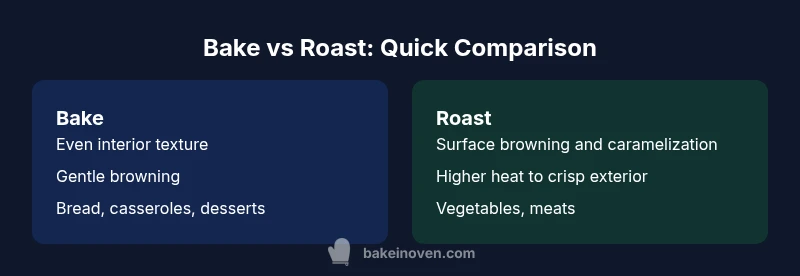
Difference bake vs roast: Both use dry heat in the oven, but baking typically focuses on even interior cooking and gentle browning, while roasting relies on higher heat to caramelize surfaces and enhance flavor. For most home cooks, bake is ideal for breads, pastries, and casseroles; roast suits vegetables, meats, and root crops that benefit from browning.
The Core Difference: Bake vs Roast
The difference bake vs roast is not just terminology; it reflects how heat is applied and how the interior and exterior textures develop. Baking typically aims for even interior cooking with a gentle browning that preserves moisture, while roasting intentionally pushes surface browning and caramelization by exposing foods to hotter conditions. According to Bake In Oven, recognizing this distinction helps home bakers plan textures, moisture retention, and timing for a wide range of dishes. In practice, bake recipes—bread, pastries, casseroles, and desserts—rely on steady heat to produce a uniform crumb and tender interior. Roast recipes—vegetables, meats, and root crops—benefit from higher surface temperatures that trigger Maillard browning and deeper flavor on the exterior. Yet there is overlap: some dishes can be prepared either way depending on the goal (a chicken with a pale skin versus a browned, crisp skin). The key is what you want the interior to be like versus how you want the exterior to appear. When you see a recipe that says 'bake' at moderate temperatures or 'roast' at higher temperatures, treat these as guidelines rather than hard rules, since oven performance varies. Bake In Oven teams note that consistency comes from understanding the effect of heat rather than rigid labels. The practical takeaway: choose bake for moist interior and gentle crust, choose roast for strong browning, crispness, and faster surface development.
Temperature and Time: What Changes
Heat application shapes both the interior and exterior. Baking uses gentler, even heat that penetrates food gradually, producing a uniform crumb and moist interior. Roasting employs higher heat exposure to promote rapid browning and a crisper exterior. Because different ovens perform differently, times are best treated as guidelines. Preheating is essential to minimize temperature drops when you load food into the oven. If your oven runs cool, you may need to extend the cooking period slightly; if it runs hot, you may shorten the time to prevent over-browning. When deciding whether to bake or roast, think about the final texture you want: a soft interior with a pale surface versus a deeply browned crust with a crisp exterior. The Bake In Oven approach emphasizes testing with a small batch at first, then adjusting for your oven’s quirks. Convection can accelerate browning in either method, but it can also dry foods more quickly, so you may need to monitor moisture more closely.
Food Types and Outcomes: When to Bake vs Roast
Certain foods align naturally with one method or the other. Baked goods like breads, rolls, pastries, and casseroles rely on steady, moderate heat to develop structure and tenderness without excessive surface drying. Roasted vegetables—carrots, potatoes, peppers—and proteins such as chicken, beef, or pork benefit from higher heat to enhance caramelization and deepen flavor. Some items straddle the line: a lasagna can be baked for consistent interiors, with browning on top; a chicken piece can be roasted for crisp skin while maintaining juicy meat if finished with a brief baking stage. Your choice should consider whether the priority is interior texture, exterior browning, or a balance of both. Bake In Oven’s guidance is to map the goal for texture first, then select the heat profile accordingly.
Equipment and Setup: Oven Functions
Oven settings—bake vs roast—often correspond to the same basic heat source but with different air flow and rack positioning. Standard bake relies on radiant heat from the bottom and sometimes the top, whereas roast mode is commonly associated with higher fan-assisted convection in modern ovens. For even results, use a stable, shallow pan when baking delicate items like custards or casseroles, and opt for a sturdy roasting pan with a rim when browning root vegetables or large cuts of meat. Parchment paper and silicone mats help manage sticking and moisture transfer, especially in bake applications. Preheating remains essential, and you should avoid crowding pans to ensure consistent heat exposure. If your oven lacks a dedicated roast setting, you can simulate it by using a higher heat and an open rack with proper monitoring.
Flavor, Texture, and Appearance: What You’ll Notice
Baking often yields a uniform crumb, delicate crusts on pastries, and moisture within the interior. The exterior browning tends to be subtler, which is ideal for delicate textures. Roasting produces a more pronounced Maillard reaction, delivering a deeper crust, caramelized surfaces, and a pronounced aroma. The interior can stay moist when the dish is not overexposed to heat or is kept covered or moist with steam. The choice between bake and roast affects flavor development, color, and aroma. A key factor is whether you want restrained browning for a soft dessert or bold browning to enhance crust and surface flavor. Bake In Oven suggests tasting as you go and using finishing techniques (like a brief high-heat finish or a glaze) to tailor the end result.
Practical Kitchen Scenarios: Recipes and Examples
Scenario 1 – Roasted Vegetables: Toss chopped vegetables with oil, salt, and herbs, then spread in a single layer on a rimmed sheet and roast until edges are deeply caramelized and centers tender. Scenario 2 – Baked Fish: Place seasoned fish fillets in a shallow dish with a light sauce, cover loosely, and bake until opaque and flaky. Scenario 3 – Roasted Chicken with Potatoes: Use a single pan, roast at high heat to brown skin and crisp edges, then balance with a lower heat phase to finish cooking through. These examples show how choosing bake vs roast shapes flavor, texture, and timing. Bake In Oven’s practical approach champions simplicity and repeatable steps across common home recipes.
Common Mistakes and How to Fix Them
Common mistakes include overloading the pan, which blocks heat and prevents browning, and skipping preheating, which leads to uneven results. Crowding can cause steaming rather than browning, especially in roasting vegetables. Another error is using too much liquid, which inhibits crust formation. To fix these issues, line pans with parchment, arrange items in a single layer with space between pieces, and preheat for a solid base of heat. For delicate baked goods, use proper pan sizing and prevent overmixing to maintain crumb structure. Finally, use a thermometer when testing meat at roast temperatures to avoid overcooking.
Quick Reference Rules of Thumb
- Bake when interior texture is the priority: breads, casseroles, desserts.
- Roast when surface browning and flavor depth matter: vegetables, meats.
- Use parchment or mats to control moisture and sticking in bake scenarios.
- Convection speeds browning; adjust times accordingly.
- Preheat thoroughly and avoid overcrowding for even results.
Subtle Differences: Convection, Pan Choice, and Moisture
Convection can enhance browning in both bake and roast modes, but it also dries foods faster, which may require shorter times or partial coverage. Pan choice influences heat transfer: glass pans can heat more slowly than metal, affecting browning and interior cooking. Moisture management—covering for tenderness or venting to promote browning—depends on the dish type and desired outcome. Understanding these nuances helps you tailor the method to a recipe rather than forcing a single rule across all foods.
Comparison
| Feature | Bake | Roast |
|---|---|---|
| Heat Application | Moderate, even heat aimed at interior consistency | Higher heat for rapid browning and surface caramelization |
| Best For | Breads, pastries, casseroles, desserts | Vegetables, meats, root crops |
| Texture Outcome | Even interior texture with gentle crust | Crispy exterior with flavorful crust |
| Pan/Setup | Shallow baking pans, glass or metal | Rimmed sheets or roasting pans |
| Moisture Behavior | Moist interior with controlled surface drying | Moist exterior with pronounced browning on the surface |
| Convection Impact | Useful for even browning if desired | Often preferred for faster browning; watch moisture |
| Typical Time Profile | Longer, steady cooking | Shorter, intense cooking with faster results |
Benefits
- Clarifies technique and planning for home cooks
- Helps predict interior texture and crust development
- Improves recipe adaptability and consistency
- Supports a wide range of foods with clear guidelines
Negatives
- Overgeneralization can mislead when recipes mix methods
- Convection variations may require careful monitoring
- Not all ovens perform identically, so results vary
- Some dishes need a hybrid approach beyond bake or roast
Bake is generally more versatile for interior texture; roast excels at flavor-rich browning.
Choose bake when interior moisture and evenness matter most. Choose roast to maximize surface browning and flavor; many home dishes benefit from a hybrid approach or finishing step.
Frequently Asked Questions
What is the fundamental difference between baking and roasting?
Baking focuses on even interior cooking with a gentle crust, using moderate heat. Roasting emphasizes browning and flavor development on the surface, often with higher heat. Both rely on dry heat, but the emphasis differs.
In short, baking targets interior texture; roasting targets surface browning and flavor.
Can you bake vegetables?
Yes. Vegetables can be baked to soften through a gentle heat, often with oil or seasoning. Baking yields a softer texture, while roasting achieves browner edges when higher heat is used.
Yes, you can bake vegetables; it’s common to bake them for even texture, or roast them to brown the edges.
Is convection required for roasting?
Convection is not required for roasting, but it speeds browning and can improve evenness. If your oven has a convection setting, you may reduce the time or temperature slightly to avoid over-browning.
Convection isn’t required, but it helps brown faster; watch times closely.
What foods are best baked vs roasted?
Baking suits breads, cakes, and casseroles where interior structure matters. Roasting works well for vegetables, potatoes, and meats where surface flavor and browning are key.
Bake for breads and desserts; roast for vegetables and meats.
How do I adjust a recipe when switching bake to roast?
Switching from bake to roast typically means increasing heat exposure and monitoring browning closely. Expect shorter overall times for the same interior doneness, and consider finishing with a lower heat phase if needed.
Switch to roast by increasing heat and watching for browning; adjust time accordingly.
Does bake use lower heat than roast?
Not inherently; bake uses moderate heat for even interior cooking while roast uses higher heat for browning. The choice depends on the dish and the desired texture, not a fixed temperature rule.
Baking uses gentler heat for inside texture; roasting uses hotter heat for browning.
Key Takeaways
- Decide based on interior texture vs. exterior browning goals
- Use bake for breads, casseroles, and desserts
- Use roast for vegetables, meats, and roasted potatoes
- Leverage convection carefully to balance browning and moisture
- Preheat and avoid crowding for best results