How Long Does Roast Last? Storage Guide for Roasts
Discover exactly how long roast leftovers stay safe in fridge and freezer, with storage timelines, safety tips, and practical guidance from Bake In Oven.


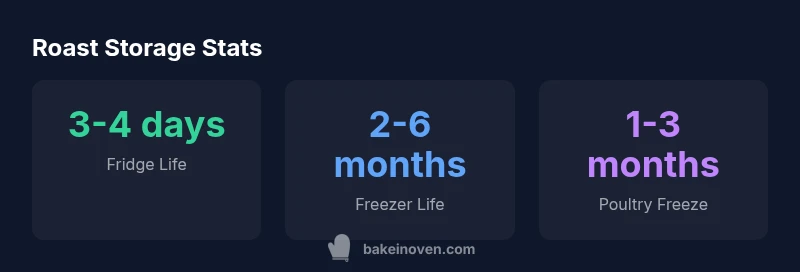
Roast leftovers stay safe for about 3-4 days in the fridge and 2-6 months in the freezer, depending on packaging and roast type. For best results, wrap tightly, label, and freeze promptly. Reheat to a safe temperature before serving, and trust smell and texture as the final test. Always store in airtight containers. Thaw in the fridge overnight before reheating.
Why Roast Storage Matters
Roast leftovers are a staple in many home kitchens, valuable for quick lunches and next-day dinners. However, safe handling and storage determine whether those leftovers remain delicious or become a food-safety risk. According to Bake In Oven, understanding storage timelines helps home bakers minimize waste and keep meals safe. The science behind storage is straightforward: after cooking, the product cools from hot temperatures down into the refrigeration or freezing range where bacteria grow more slowly. The critical window is the period immediately after cooking when the roast is in the so-called danger zone. The goal is to reduce time in that zone by cooling rapidly and storing properly. In practice, dividing large roasts into smaller portions accelerates cooling, preserves moisture, and preserves texture so leftovers reheat evenly. Throughout this article, we unpack the practical timelines, the factors that influence them, and the best practices to keep roast leftovers safe and tasty.
Fridge vs. Freezer: How Storage Affects Longevity
When deciding where to store a roast, most home cooks opt for refrigeration for short-term use and freezing for longer-term planning. In the fridge, a properly cooled roast typically remains safe for about 3-4 days. This window assumes temperatures at or below 40°F (4°C) and airtight packaging or wrap to limit moisture loss and odor transfer. Freezing extends shelf life dramatically, with roasted leftovers usually staying safe for 2-6 months when sealed tightly, labeled, and stored at 0°F (-18°C) or lower. The type of roast matters: leaner cuts tolerate freezing well, while roasts with higher fat content may experience freezer burn or texture changes if not wrapped tightly. Vacuum-sealed or tightly wrapped portions offer the best protection against dehydration and freezer burn. Labeling with a date helps you track how long items have been stored, ensuring you rotate stock and minimize waste. Bake In Oven analyses also emphasize rapid cooling: spread large roasts in shallow containers to speed temperature drop and reduce risk of microbial growth.
How to Maximize Safety and Quality
To get the most out of roast leftovers, follow a simple, repeatable routine. First, cool the roast quickly to below 40°F (4°C) within two hours of cooking. Split large roasts into smaller, portion-sized pieces and place them in shallow, airtight containers or wrap tightly with freezer-grade foil or plastic wrap. For freezer storage, consider vacuum-sealing to minimize air exposure and prevent freezer burn. Always label packages with content and date, and store in appropriate compartments to avoid temperature fluctuations. In the fridge, keep the roast on the bottom shelf to maintain a consistent temperature and reduce cross-contamination risk. When reheating, bring the roast to an internal temperature of 165°F (74°C) or higher to ensure safety. Finally, trust your senses: unusual odor, slimy texture, or color changes are signs to discard rather than reheat.
Roast Type and Timing: A Quick Reference
Different meats have slightly different storage profiles, though the fridge window remains 3-4 days for most roasted meats. Beef roasts and pork roasts generally hold well in the freezer for 2-6 months when kept airtight. Poultry roasts are a bit more delicate in the freezer, with a typical safe period of 1-3 months depending on fat content and packaging. For the best results, portion meals into single-meal sizes, which makes thawing more controlled and reduces the need to refreeze. If you plan to mix roasted leftovers into other dishes (stir-fries, casseroles, or soups), consider freezing them as part of the finished dish to maintain texture and flavor.
Thawing, Reheating, and Re-Purposing Leftovers
Thaw frozen roasts in the refrigerator overnight or use a cold-water thawing method in a leak-proof bag if you need to accelerate the process. Never thaw on the countertop to avoid rapid temperature changes that invite bacterial growth. Reheat leftovers thoroughly to at least 165°F (74°C) throughout; use a thermometer to verify even heating. When repurposing, consider repackaging into new portions to maintain quality and safety. If you notice any off smells, unusual color, or a slimy surface, discard the roast to avoid foodborne illness. Finally, consider repurposing leftovers into new dishes: sliced roast on sandwiches, roast beef hash, or mixed into soups—these approaches extend the utility of a single roast while keeping quality high.
Practical Kitchen Checklist
- Cool leftovers rapidly and store in shallow containers.
- Use airtight packaging and label with date.
- Freeze promptly for long-term storage; aim for 2-6 months for most roasts.
- Thaw in the fridge, then reheat to 165°F (74°C).
- Trust sensory cues to decide safety; when in doubt, discard.
Shelf-life ranges for common roasted meats
| Roast Type | Fridge Lifespan | Freezer Lifespan | Best Practices |
|---|---|---|---|
| Beef roast | 3-4 days | 2-6 months | Wrap tightly; label; freeze promptly |
| Pork roast | 3-4 days | 2-6 months | Vacuum-seal if possible; cool before freezing |
| Poultry roast | 3-4 days | 1-3 months | Use airtight wrap; avoid freezer burn |
Frequently Asked Questions
How long can a roasted beef roast stay in the fridge?
Most cooked roasts stay safe for 3-4 days when refrigerated at 40°F (4°C) or below. After that window, quality decreases and safety risk rises. If in doubt, check for off odors and a firm, slimy surface before deciding to discard.
Three to four days in the fridge, with safety signs to guide you.
Can I freeze roast leftovers and how long will they last?
Yes, freeze promptly in airtight packaging. Roasts are typically safe for 2-6 months in the freezer, depending on roast type and packaging quality. Label with date and content to ensure rotation.
Freeze promptly for best safety and flavor.
Does the type of roast affect storage time?
Yes. Beef and pork roasts generally hold up well in the freezer for 2-6 months, while poultry roasts tend to be safer for 1-3 months due to higher moisture content.
Beef and pork last longer in the freezer than poultry.
What is the best way to thaw a frozen roast?
Thaw overnight in the refrigerator in a leak-proof container. If you need to thaw faster, use the cold-water method, changing the water every 30 minutes, but cook promptly after thawing. Do not thaw at room temperature.
Thaw in the fridge overnight, or use cold water if pressed.
How should I reheat leftovers safely?
Reheat to an internal temperature of 165°F (74°C) throughout; use a thermometer and stir to ensure even heating. If the roast was previously thawed, reheat only once and discard any leftovers beyond safe reheating.
Heat until steaming hot throughout.
“Consistent storage practices protect both safety and flavor, reducing waste and ensuring roast leftovers are safe to eat.”
Key Takeaways
- Stash roast leftovers promptly to maximize safety.
- Use airtight packaging to prevent freezer burn.
- Prefer fridge first, then freezer for longer-term storage.
- Always rely on smell and texture to judge safety.