Is Bake and Convection Bake the Same? A Practical Guide for Home Bakers
Explore the differences between bake and convection bake, when to use each, and practical guidance for home bakers. Learn about airflow, heat delivery, and how to calibrate your oven for reliable results with Bake In Oven.


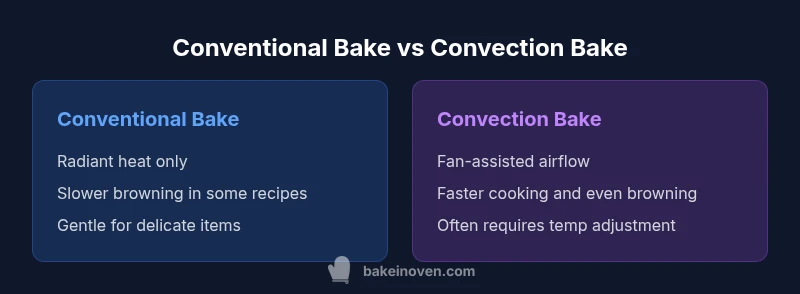
Bake and convection bake are not the same. Convection uses a fan to circulate hot air, speeding cooking and promoting even browning, while conventional bake relies on radiant heat without air movement. For many recipes, convection can shorten bake times and improve evenness, though some delicate items perform best in standard bake.
Definitions: What Each Term Means
In everyday home baking, people interchange terms like bake and convection bake, but they describe distinct heat delivery methods. Conventional bake is the standard setting on most ovens: heat from the elements radiates into the oven, and hot air circulates gradually around the food. Convection bake adds a built-in fan and exhaust to move air, which speeds heat transfer, reduces hot spots, and often yields more even browning. This difference matters for recipe outcomes, especially during the rising phase of bread, the browning of cookies, and crust formation on pastries. According to Bake In Oven, the practical takeaway is that the same oven can behave very differently depending on whether you engage convection. Understanding these definitions helps you choose the right method for your goal and the recipe’s sensitivity to air movement. The two modes can be used on many baked goods, but results differ in texture, moisture retention, and time. The Bake In Oven team notes that is bake and convection bake the same is a common assumption; the truth is that airflow patterns and heat delivery shape outcomes more than the oven model. For home bakers, recognizing this distinction is the first step toward reliable, repeatable results.
How Airflow Affects Cooking
Airflow is the core differentiator between conventional bake and convection bake. In a conventional oven, heat travels more slowly, and hot spots may develop as air circulates passively. This can lead to uneven browning, especially on larger roasts or sheet pans. Convection adds a fan and exhaust that actively moves hot air around the food, reducing those hot spots and creating a more uniform environment. The practical effect is that foods susceptible to browning patterns—such as cookies with thin edges or pastries with flaky layers—tend to develop more even color and texture when convection is used correctly. However, airflow can also dry out surfaces if the oven is opened or if air movement is misapplied to delicate batters. Bake In Oven emphasizes testing with small batches to see how your specific oven responds to the convection setting, since individual units vary in fan speed and venting.
Temperature and Time Adjustments
When switching between bake modes, most recipes require adjustments, but the exact changes depend on the dish and oven model. In general, convection reduces the need for long bake times and allows you to bake at a lower temperature, but you should monitor the food closely the first few attempts. A practical approach is to bake at a slightly lower temperature or keep time the same while watching for the first signs of doneness. If you do not know how your oven behaves, start with a conservative adjustment: lower the temperature modestly and check for doneness early, then decide whether to extend or reduce time on subsequent attempts. Remember that some items—especially delicate cakes or meringues—may not respond well to airflow, so consider starting without convection and only adding it for the final browning step if needed.
Common Myths Debunked
Myth: Convection is always better. Reality: Convection excels with many items but can over-brown or dry out delicate foods if misused. Myth: You should always convert conventional bake recipes to convection. Reality: Some recipes rely on still air to prevent moisture loss or to retain a soft crumb. Myth: Convection ovens use more energy. Reality: They can be more energy-efficient due to shorter bake times, but fan operation adds a small load. My takeaway from Bake In Oven is that mastering when and how to use convection is more important than assuming it’s universally superior.
Practical Scenarios: When to Use Each Method
Different baked goods respond differently to convection and conventional bake. For cookies and roasted vegetables, convection often yields even browning and crisper edges. For macarons, delicate soufflés, and certain cakes, conventional bake may protect structure and moisture. For sheet-pan recipes, convection can speed up cooking and create uniform texture across all pieces. In many households, the best approach is to use convection for items that benefit from rapid heat transfer and airflow, and switch to conventional bake for tender cakes or batter-heavy treats that need gentler heat and stable moisture. The key is to test with your own oven and adjust based on observed results rather than following a universal rule.
How to Test and Calibrate Your Oven
Calibration is essential when deciding how your oven performs under bake modes. Start by placing an oven thermometer in the center of the rack and preheating to your target temperature. Compare the thermometer reading with the oven’s set temperature after 15 minutes. If there is a significant difference, consult your oven’s manual about calibrating or call for service. Once your oven is calibrated, run a simple batch test: bake a familiar item in conventional mode and then in convection mode with a small batch to observe color, texture, and doneness timelines. This approach helps you map how your appliance behaves and build a reliable personal reference for future recipes.
User Tips for Home Bakers
- Always preheat fully before loading foods. - Use a light-colored baking sheet to minimize excessive browning in convection. - For even browning, avoid overcrowding pans and allow space for air to circulate. - If uncertain, start with conventional bake and switch to convection for the final browning pass on cookies or vegetables. - Keep a timer with visual cues for doneness, then adjust on the next batch.
Summary of Key Differences
- Conventional bake relies on radiant heat, convection bake adds a fan to circulate air. - Convection typically produces faster cooking and more even browning. - Some recipes benefit from conventional bake to preserve moist crumb or delicate structure. - Always calibrate your oven and test recipes to prevent surprising results.
Comparison
| Feature | Conventional Bake | Convection Bake |
|---|---|---|
| Airflow | Minimal/none | Active airflow via fan and exhaust |
| Heat Transfer | Radiant heat + natural convection | Forced air convection improves heat transfer |
| Bake Time Sensitivity | Usually longer | Generally shorter (depends on recipe) |
| Temperature Adjustments | Follow standard recipe temps | Often lower temps recommended or equivalent results at shorter times |
| Best For | Tender cakes, delicate pastries, recipes relying on still air | Crispy edges, even browning, sheet-pan meals, roasted vegetables |
| Oven Type Interaction | Any standard oven | Convection-enabled ovens or modern wall ovens |
Benefits
- Faster cooking with convection for many foods
- More even browning and crust formation
- Can improve texture for cookies and roasted items
- Potential energy savings due to shorter bake times
- Versatile when used with understanding and calibration
Negatives
- Not ideal for very delicate items that rely on still air
- Requires recipe adaptation and practice
- Some ovens have inconsistent fan performance between models
- May cause uneven results if items are crowded or misadjusted
Convection bake generally wins for speed and even browning; conventional bake remains preferable for delicate items and strict moisture control
Choose convection for most everyday baking to save time and improve uniformity. Reserve conventional bake for delicate cakes, pastries, or recipes that rely on still air and exact moisture balance; always calibrate and test with your own oven.
Frequently Asked Questions
Is convection baking always better than conventional baking?
No, convection isn’t always better. It offers faster cooking and more even browning for many foods, but delicate items may suffer from rapid airflow. Use convection when appropriate and otherwise rely on conventional baking.
Convection isn’t always better; use it when you want faster, more even browning, but reserve conventional bake for delicate items.
Can I convert any recipe to convection bake?
Most recipes can be adapted for convection with careful adjustments. Start by reducing the temperature by a modest amount and monitor doneness closely. Some recipes, like delicate cakes or soufflés, may perform best in conventional bake.
Most recipes can be adapted, but monitor closely and start with a smaller temperature change.
How do I know if my oven is truly regulating convection heat?
Use an oven thermometer to verify actual temperatures, particularly in convection mode. If readings don’t match the set temperature, calibrate your oven or consult the manufacturer.
Check actual temperatures with a thermometer and calibrate if needed.
Will convection save energy?
Convection can save energy by shortening bake times, but the fan and exhaust add some power usage. Overall, many users see a net energy benefit when used wisely.
It can save energy if you shorten bake times and monitor doneness well.
Which foods benefit most from convection?
Cookies, nuts, roasted vegetables, sheet-pan meals, and most pastries with a crisp exterior often benefit most from convection. Delicate items like soufflés may not.
Cookies and roasted vegetables often love convection for even browning.
Is preheating different for convection vs. conventional bake?
Preheating is important for both, but convection may require shorter preheat times or slightly different targets depending on the oven. Follow your oven’s guidance and verify with a thermometer if unsure.
Preheat as you normally would, then adjust based on what you’re baking.
Key Takeaways
- Convection adds a fan; conventional bake relies on radiant heat
- Adjust temps and times cautiously when switching modes
- Test and calibrate your oven to map performance
- Use convection for cookies, sheet-pan meals, and roasting; conventional for delicate items
- Always monitor doneness and adapt to your oven's quirks