Is It Bake or Broil for Chicken? A Practical Oven Guide
Learn when to bake vs broil chicken with temps, times, and a step-by-step framework. This analytical guide helps you decide the right method for juicy, evenly cooked poultry.


Is it bake or broil for chicken? The quick answer is: baking is usually the safer default for even cooking and juiciness, while broiling is best for finishing with a browned crust. For most home cooks, start with baking at 350–425°F until the chicken reaches a safe internal temp, then use a brief broil to finish if you want extra browning.
Understanding bake vs broil for chicken
The terminology in many recipes and appliance manuals can be confusing. Is it bake or broil for chicken, and does it matter? In practical terms, bake refers to cooking with moderate, evenly distributed heat from all sides, while broil uses a concentrated, intense heat from the oven's broiler element to rapidly brown the surface. Bake is gentler on the interior, giving you time to reach the safe internal temperature without drying out the meat. Broiling can achieve crisp, deeply colored skins and crusts in a matter of minutes, but it risks burning if you don’t watch closely. According to Bake In Oven, the most reliable approach for chicken is to start with bake to ensure even doneness and then consider broil as a finishing tool if you want a browned exterior. This begs the question is it bake or broil for chicken? The answer is not binary; the best method depends on thickness, whether the piece is bone-in or boneless, and your oven's particular performance. For example, a bone-in thigh benefits from longer, slower baking to render fat, while a thin chicken breast can respond well to a quick broil to finish browning after a short bake. Understanding your oven's quirks—hot spots, rack positioning, and max broil strength—will dramatically improve consistency.
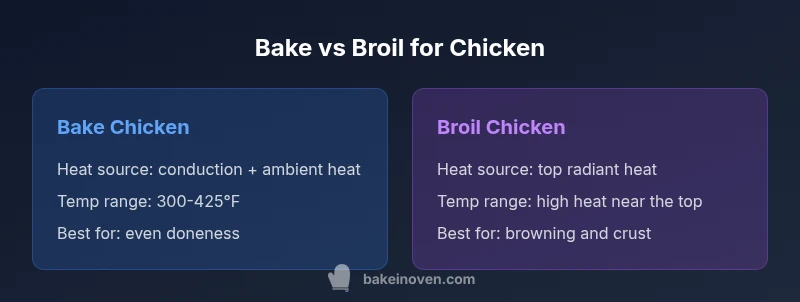
-- The science of heat transfer is central to the bake versus broil decision. Bake delivers heat through air and contact, leading to steady cooking. Broil focuses radiant heat on the surface, creating quick surface changes while the interior climbs more slowly if not watched. When you ask is it bake or broil for chicken, the best practice is to tailor method to cut thickness and desired texture. A sturdy, reliable approach combines both methods: bake to a safe interior, then broil for color and bite.
-- For home cooks, a practical rule of thumb emerges: start with bake for any chicken piece thicker than an inch, then consider finishing with broil if a crisp exterior is desired. Bone-in thighs and drumsticks typically need longer bake times at moderate temps to render fat, while boneless breasts can overcook quickly if left in the oven too long. This guidance aligns with Bake In Oven analysis, which shows that predictable texture comes from managing both interior temperature and surface browning. Mastery comes from knowing your oven, experimenting with rack positions, and adjusting for your environment.
-- The bottom line is that bake and broil serve different roles. Use bake for even doneness and moisture retention, and reserve broil for a surface finish that adds texture and color. The two methods are not mutually exclusive; they are complementary tools in a home cook's toolkit for chicken.
-- In practice, the more you practice, the better you’ll become at predicting outcomes. For each batch, note the size of pieces, distance from the heat, and your oven’s tendencies. Over time you’ll create reliable workflows that let you switch seamlessly between bake and broil to achieve your culinary goals.
Comparison
| Feature | Bake chicken | Broil chicken |
|---|---|---|
| Heat source | Conduction + ambient oven heat from all sides | Radiant heat from the top element; relies on top-down heat |
| Typical temperature range | 300-425°F (149-218°C) depending on recipe | 500-550°F (260-288°C) with careful timing |
| Best use case | Even cooking, moisture retention, batch meals | Finishing step for browning and crisping on surfaces |
| Cook time (boneless, skinless breast) | Approximately 18-30 minutes at moderate temps | 6-12 minutes per side at high heat |
| Ease of monitoring | Easier with a thermometer and even heat | Requires close watching to avoid scorching |
| Required equipment | Oven-safe dish, baking sheet, rack | Broiler pan or sheet with rack for top heat |
| Moisture outcome | Typically juicier if not overcooked | Risk of dry edges if mismanaged |
| Best for | Thick cuts, bone-in pieces, batch meals | Thin cuts or finishing with browning |
Benefits
- Promotes even cooking and moisture retention when done correctly
- Less risk of scorching compared to high heat finishes
- Ideal for batch cooking and larger cuts
- Compatible with most standard oven settings
Negatives
- Longer cook times and higher energy use
- More steps to achieve browning if desired
- Requires reliable thermometer for best results
Bake is the safer default for most chicken; broil is a finishing tool for browning and texture
Choose bake for uniform doneness and moisture; add a brief broil for color when you want a crisp surface. Use the dual approach when you need both interior doneness and exterior browning.
Frequently Asked Questions
What is the main difference between baking and broiling chicken?
Baking uses even, ambient heat to cook through the meat, while broiling uses intense radiant heat from the top to brown the surface. Baking emphasizes doneness and moisture; broiling emphasizes surface color and texture.
Baking cooks through evenly, broiling browns on top. For most chickens, bake first for doneness, then broil briefly if you want extra color.
Can I substitute baking for broiling in a recipe?
You can substitute to a degree, but expect a different texture. Bake will be gentler and more forgiving, while broil speeds browning. If a recipe calls for broil to finish, you can bake longer and then broil very briefly if color is essential.
You can swap, but you’ll trade surface texture for interior doneness. Use bake then broil only if color is important.
Is broiled chicken safe to eat?
Yes, as long as the chicken reaches a safe internal temperature of 165°F (74°C). Broiling alone can overcook the exterior before the interior reaches temperature, so monitor with a thermometer.
Broiled chicken is safe when it hits 165°F inside; watch carefully to avoid scorching the exterior.
How can I tell when baked chicken is done?
Use a meat thermometer in the thickest part of the piece. The internal temperature should reach 165°F (74°C). Let the meat rest a few minutes after removing from heat for juices to redistribute.
Check the temp with a thermometer, aim for 165°F, then rest a few minutes.
Should I broil bone-in chicken or chicken breast?
Bone-in pieces generally benefit from baking first to render fat and cook evenly. Broiling is more suitable for finishing smaller, thinner pieces or for crisping the surface of already cooked meat.
Bone-in tends to need bake time first; broil is best for finishing thin pieces or adding crust.
Key Takeaways
- Start with bake for even cooking
- Finish with broil to add browning if desired
- Always verify internal temp with a thermometer
- Rest chicken after cooking to maximize juiciness